
World Center for Strategic Studies
From closed analysis to public debate

- MONTH
- YEAR

Is the Old World Fearful of the Promised Land? EU Stays Gutless to Act Against Israel
Despite widespread human rights violations, the European élite refuses, for some reason, to break a pact that grants Israelis access to business and more than a billion euros till 2027.
As Eldar Mamedov writes for Responsible Statecraft, this is the case even though more than a million EU citizens have called for suspension of the EU-Israel Association Agreement.
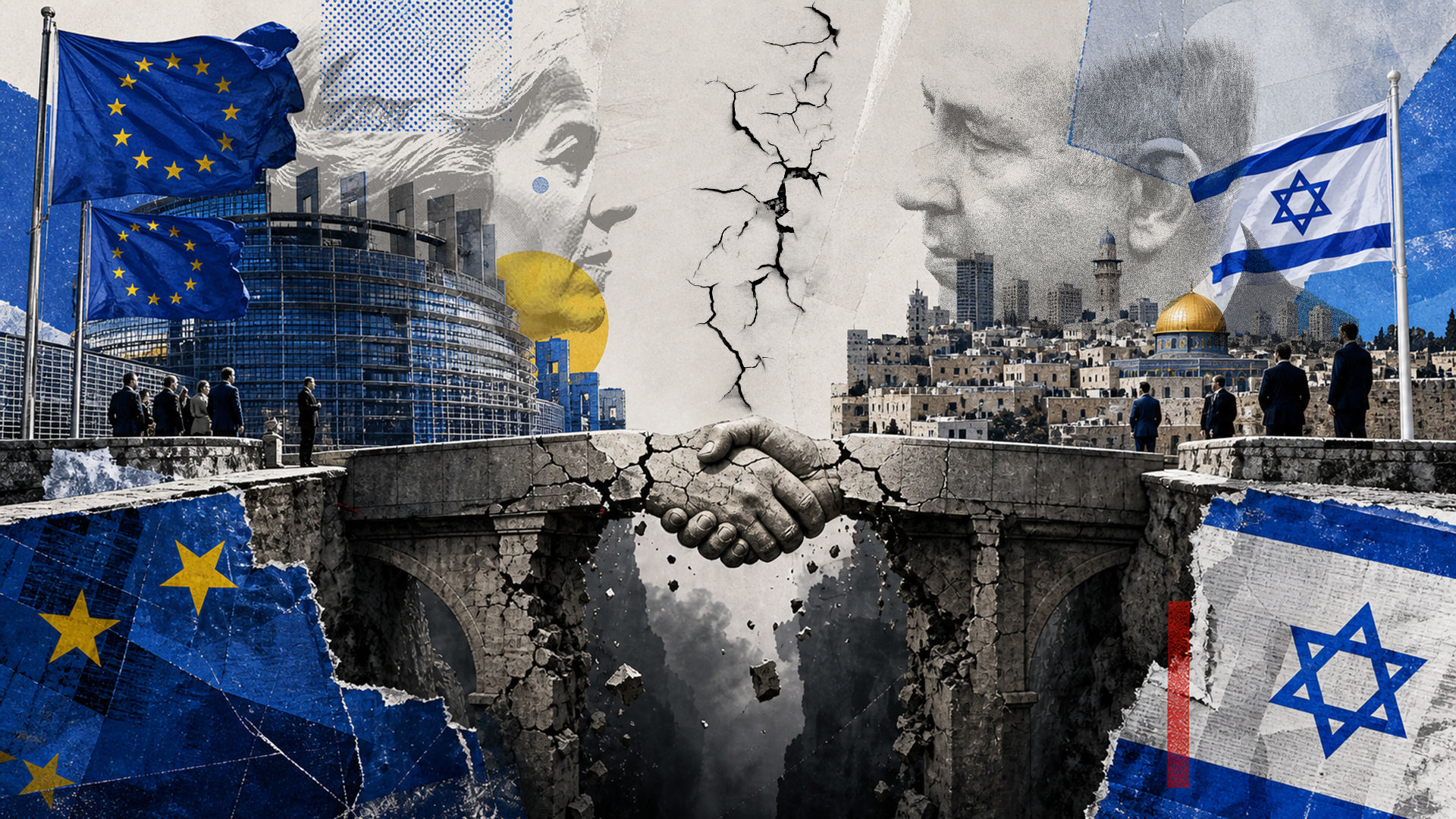
Over 350 former diplomats and 60 NGOs, including Amnesty International and Human Rights Watch, have endorsed the proposal and reminded EU ministers of their obligation to ‘employ all reasonable means to prevent genocide.’
The agreement, which came into effect in 2000, is the framework for the EU–Israel relations. It grants Israel preferential access to EU markets. The agreement also provides for cooperation in other key areas, such as diplomatic dialogue and research.
The pact also enables Israel’s participation in the EU-funded Horizon program on research and innovation, which made a total of 1.11 billion euros available for Israeli companies, universities, and public organizations until 2027. Rights groups fear that some of these funds could be spent on dual-use technologies facilitating militarization, repression, and surveillance.
Like similar EU agreements with third countries, the deal with Israel includes a human rights clause, namely Article 2, which stipulates that ‘cooperation is based on respect for human rights and democratic principles’.
It is based on this clause that Spain, Slovenia, and Ireland proposed to suspend the agreement. In a joint letter to the EU high representative on foreign policy Kaja Kallas, the foreign ministers of the three countries pointed to concrete breaches of Article 2 of the agreement.
The letter cited a recently passed Israeli law imposing the death penalty on Palestinians convicted in military courts, the humanitarian catastrophe in Gaza, and settler violence in the West Bank carried out with reported impunity. The letter also pointed to ‘recurrent attacks against religious freedom of Muslims and Christians that challenge the status-quo of the Holy Land.’ And on Lebanon, the foreign ministers noted that Israeli military operations there were carried out with ‘absolute disregard of international law and international humanitarian law.’
Hypocrisy could not be more blatant. Those same European capitals that rushed to impose sanctions on Russia a few days after it invaded Ukraine now linger for years in search of excuses for no action against Israel. The sanctions against Moscow have been quick and large-scale, welcomed as defense of a ‘rules-based international order’.
And when it comes to Israel, they procrastinate. No one wants dialogue with Israel broken off, but it should go along with holding it responsible – unlike what happens in the case of Russia’s invasion of Ukraine.
The message sent by the EU is unambiguous: some violations are unacceptable, and others are just a nuisance. The more Israel escalates the situation, the more the EU’s submission to Tel Aviv brings out the deeply unsound nature of their relationship.
As if to underscore this surreal disconnect, on the very same day that EU ministers failed to take any meaningful action against Israel, Ursula von der Leyen, the Commission’s president, was speaking elsewhere about the urgent need to protect Europe from ‘Russian, Chinese and Turkish influence.’ Not a word about Israeli influence. The conclusion is that Europe is banally fearful of Israel.