World Center for Strategic Studies
From closed analysis to public debate

- MONTH
- YEAR

Europe’s Southern Border Trap: Russia, Smugglers And The Sahel Squeeze
Europe keeps treating migration as a border problem. The RIEAS research paper says that is now dangerously outdated. The real pressure starts much further south – in the Sahel, Central Africa, Sudan and Libya – where jihadist violence, coups, state collapse, organised crime, climate stress and foreign meddling are feeding displacement long before people reach the Mediterranean.
The paper’s warning is sharp but careful. It does not claim there is conclusive public proof that Moscow is running a master plan to push migrants towards Spain, Italy and Greece. But it argues Russia has built enough presence, access and influence along key African corridors to exploit migration pressure in a future hybrid confrontation.
Europe’s southern flank is no longer just a humanitarian route. It is becoming a strategic pressure zone.
Ceuta showed the danger
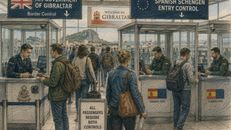
The 2021 Ceuta crisis is treated as the clearest warning. Around 8,000 people entered the Spanish enclave after Moroccan border controls were relaxed during a diplomatic row with Madrid.
That number matters because the paper explicitly corrects inflated claims of 60,000 entrants. The point is not the larger myth. The point is the mechanism.
A neighbouring transit state does not need to force people onto boats to weaponise migration. It can simply loosen enforcement, tolerate smugglers, spread rumours of open routes or link migration cooperation to diplomatic concessions.
That is the nightmare for Spain: dependence on border cooperation that can suddenly become leverage.
The Sahel is the source of pressure
The paper maps a grim displacement engine across Mali, Burkina Faso, Niger and neighbouring states.
Jihadist groups linked to al-Qaeda and Islamic State are expanding. Military regimes are struggling or using brutal counterinsurgency. Climate stress, food insecurity, land conflict and weak governance are making the crisis worse.
By April 2025, about 4.3 million people were forcibly displaced across the Sahel, almost double the level recorded at the end of 2020. UNHCR expects the broader Sahel region to host around 5.6 million forcibly displaced and stateless people by the end of 2026.
Most people stay in Africa. But when protection, work and legal status fail in first destinations, secondary migration can push northwards over time.
Russia does not need to command every route
The paper’s most important claim is about capability, not proven intent.
Russia has built a security architecture across parts of Africa through Wagner-linked structures, the Africa Corps, military advisers, intelligence personnel, political networks, arms deliveries and information operations. Its influence reaches Mali, Burkina Faso, Niger, the Central African Republic, Sudan and Libya – states that either generate displacement, absorb it or sit along routes towards Europe.
That does not prove Moscow is directing migration flows.
But it means Russia is increasingly positioned inside the system that produces them.
Libya is the critical junction
Libya is where the security risk becomes most direct for Europe.
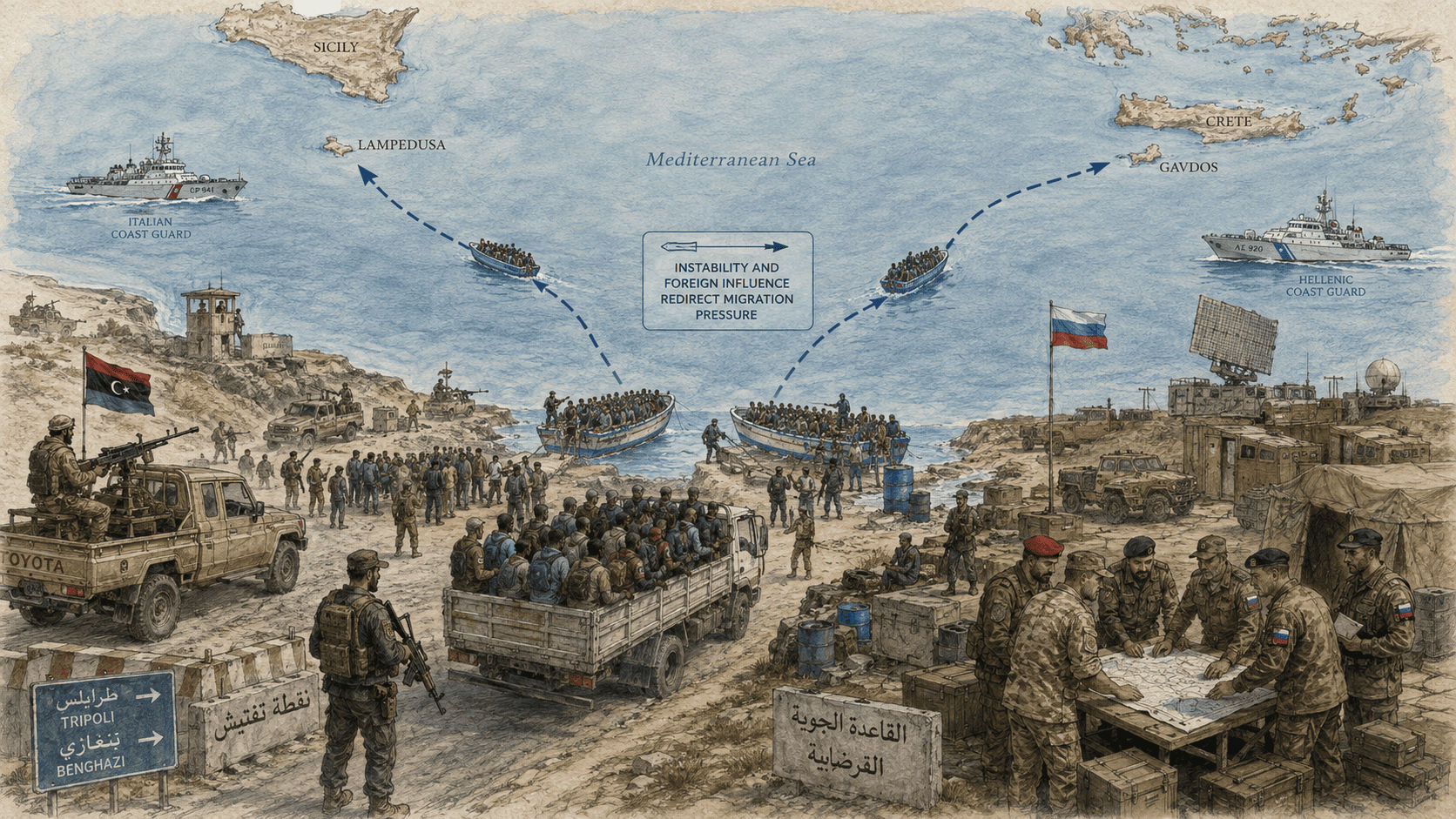
The country remains fragmented, armed groups control territory, smuggling networks operate widely, and eastern Libya is linked to Khalifa Haftar’s forces, where Russian-associated actors have influence and access.
For Italy, this affects the central Mediterranean route towards Lampedusa and Sicily. For Greece, it creates a newer and more worrying route from eastern Libya towards Crete and Gavdos.
The paper says Greece can no longer think of African migration mainly through the Turkey–Aegean lens. In 2025, nearly 20,000 people reportedly arrived in Crete from Libya, and the route from eastern Libya more than tripled.
That is a new southern security front for Athens.
Italy carries the biggest burden
Italy remains the main destination on the central Mediterranean route. In 2025, it recorded 66,316 sea arrivals, broadly similar to 2024.
The risk is not just numbers. It is volatility.
Conflict in Libya, shifts in coastguard enforcement, foreign bargaining, smuggler adaptation or instability in Sudan and the Sahel could rapidly change departure patterns. Stronger controls on one route may simply redirect boats elsewhere.
That means Italy and Greece cannot defend themselves through separate national playbooks. Their routes are part of the same system.
Information warfare makes it worse
RIEAS argues that Russia’s greatest advantage may not be physically moving migrants but exploiting the political fallout once they reach Europe.
Migration crises are perfect material for polarisation. They can be framed as proof that governments have lost control, that Europe is hypocritical, that humanitarian law is failing, or that the EU is disintegrating.
The result is a cheap strategic weapon. Migration pressure consumes resources, divides governments, boosts extremist narratives, undermines confidence in institutions and distracts attention from Ukraine and defence.
That is hybrid warfare without tanks.
Spain, Italy and Greece need a shared warning system
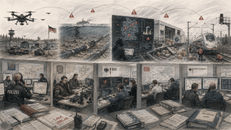
The paper calls for a permanent Southern European Migration Intelligence Coordination Mechanism linking border police, coastguards, military and civilian intelligence, Europol, Frontex, diplomats and open-source monitoring.
The proposed warning indicators are practical: conflict escalation in the Sahel, displacement movements, Russian or other foreign security activity, changes in Libyan or Moroccan enforcement, vessel purchases, smuggling prices, weather, social-media rumours about open routes and sudden migrant concentrations near departure areas.
The message is blunt: Europe cannot wait until boats appear.
The uncomfortable truth: Europe’s border starts in the Sahel
The RIEAS paper does not say migrants are the enemy. It says migrants are often the first victims of war, state collapse, terrorism, poverty and geopolitical competition.
The danger comes from actors who manipulate that suffering for political effect.
Europe’s mistake is treating migration, organised crime, Russian influence, Libyan instability, Sahel violence and information warfare as separate files. They are now connected.
If the EU keeps reacting only at Ceuta, Lampedusa, Crete and the Canary Islands, it will stay behind the crisis.
The southern frontier is already moving south – and Europe is still looking at the shoreline.