
World Center for Strategic Studies
From closed analysis to public debate

- MONTH
- YEAR

Europe’s AI Dark Age: Brussels May Regulate Its Way Into Dependence
Europe has a rare chance to close part of its productivity gap with America through artificial intelligence. The CEPA commentary warns that Brussels and national governments may blow it by reopening the very copyright rules that allow AI models to learn.
The argument is simple and severe. Europe already trails the US on growth, compute, energy and frontier technology. If it now makes AI training legally harder, costlier and more uncertain, it will not protect European sovereignty. It will deepen dependence on foreign models trained elsewhere.
Europe wants to be an AI power. But it risks building a legal moat around its own decline.
The productivity gap is brutal
CEPA starts with a grim comparison. Over the past three decades, American output per hour has risen by 85 percent, while Europe’s has grown by only 29 percent.
That gap is not a minor statistic. It is the slow erosion of European economic power.
AI offers a chance to reverse some of that decline by boosting productivity in science, medicine, industry, software, services and the arts. But that opportunity depends on whether European developers can train, adapt and deploy models without drowning in legal friction.
The window is open. Brussels may be about to slam it shut.
Copyright becomes the battlefield
The core fight is over the EU’s text and data mining exception, created in the 2019 Digital Single Market Copyright Directive.
That framework allowed automated analysis of publicly available data while giving rightsholders a machine-readable opt-out. CEPA sees it as a sensible compromise: machines can learn, creators can reserve rights, and innovators get a predictable baseline.
Now parts of the European Parliament and some national governments are considering tighter rules, including prior authorisation, opt-in defaults or statutory levies on AI training data.
That could turn AI development into a permission maze.
Startups will be crushed first
Big American tech firms can afford lawyers, licensing deals and compliance teams.
European startups cannot.
That is the first danger. If training data rules become transaction-heavy, only the largest players will survive. Smaller European firms, open-source projects and university-linked developers would face costs and uncertainty they cannot absorb.
The result would be bitterly ironic. Rules meant to restrain Big Tech could hand Big Tech even more power.
Europe would not democratise AI. It would concentrate it.
Data poverty would join compute poverty
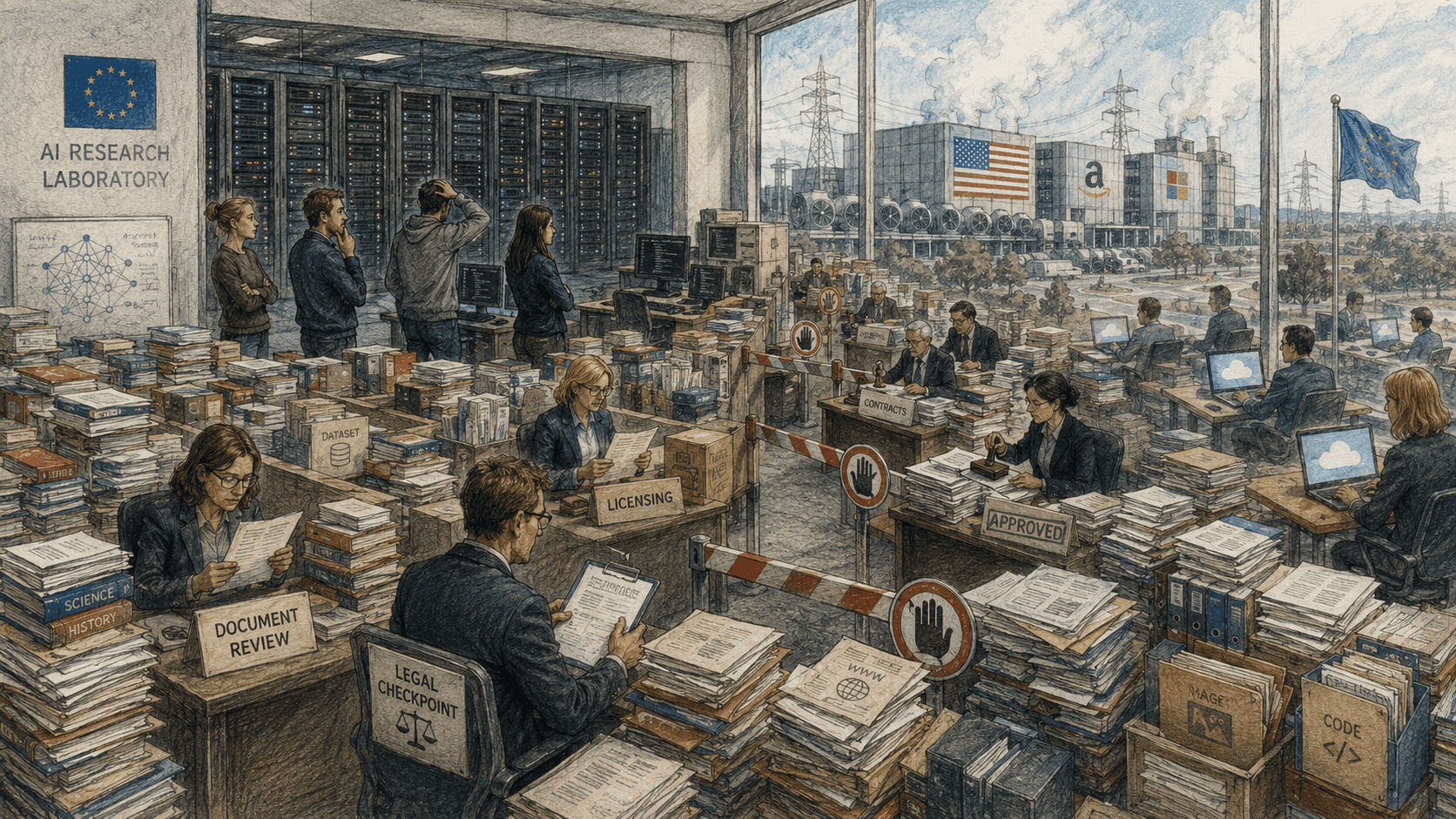
Europe already suffers from a compute deficit compared with the United States. It lacks the same hyperscale infrastructure, cheap energy base and giant AI investment flows.
Making training data harder to use would add another weakness.
CEPA’s warning is blunt: if Europe becomes data-poor as well as compute-poor, domestic AI development may stall entirely. Models need data to learn patterns, language, concepts and code. Cutting them off from usable public data does not create sovereignty.
It creates a continent that imports intelligence from abroad.
Sovereignty is being misunderstood
European policymakers often say they want technological autonomy. But autonomy requires the ability to build, adapt and fine-tune models inside Europe.
If open European models cannot learn from public European data, and companies cannot fine-tune them freely for local needs, users will simply turn to offshore systems trained under more permissive regimes.
That means less European choice, less European control and more dependence on foreign infrastructure, foreign legal systems and foreign providers.
The sovereignty agenda could end up producing the opposite of sovereignty.
Punish bad outputs, not learning
CEPA does not dismiss creator concerns. It argues that policymakers are targeting the wrong place.
If an AI system produces output that copies protected work or misuses someone’s likeness, copyright and related laws should respond to that output. But restricting the act of learning from public material is a different and more dangerous move.
The commentary draws a clear line: training is not the same as publishing a copy. Confusing the two risks treating machine learning as theft by default.
That would make Europe hostile to one of the basic processes behind AI progress.
France shows the danger
The French Senate’s April 2026 move towards a restrictive presumption that AI models exploit cultural content is a warning sign.
It reflects a real fear about culture, media and creative industries. But if that fear becomes the basis for broad restrictions, Europe could end up protecting legacy systems by throttling its future competitors.
Culture needs protection. But a continent that blocks learning will not become more creative.
It will become less relevant.
The verdict: Europe cannot sue its way to AI power
The CEPA commentary delivers a hard warning to Brussels: do not reopen the 2019 text and data mining framework in a panic.
Make opt-outs clearer, standardised and predictable. Punish infringing outputs. Protect creators where harm is real. But do not turn AI training into a legal swamp that only the richest foreign platforms can navigate.
Europe says it wants an AI future.
If it makes machines ask permission to learn, it may get an AI dark age instead.