
World Center for Strategic Studies
From closed analysis to public debate

- MONTH
- YEAR

Britain’s Climate Reality Check: Fires Are Now An Economic Threat
Europe is burning, and Chatham House says Britain’s new government cannot treat this as another summer emergency. Record heatwaves, drought and wildfires have exposed a harsh truth: climate adaptation is still treated as a side issue when it should be at the centre of economic policy, public investment and foreign policy.
The warning is blunt. Cutting emissions remains essential, but it is no longer enough. Some climate damage is already locked in. Schools are closing, transport is disrupted, thousands are dying in heatwaves, and fires are stretching emergency services from Spain and France to Scotland and Suffolk.
For Andy Burnham’s government, the test is no longer whether Britain can talk about climate leadership. It is whether it can make the country livable, insurable and resilient in a hotter world.
Europe is already burning
The commentary starts from a brutal summer picture. Wildfires have swept across Europe and parts of North Africa. Spain declared a national emergency in the Madrid region, while France requested help through the EU civil protection mechanism as it faced its worst fires in two decades.
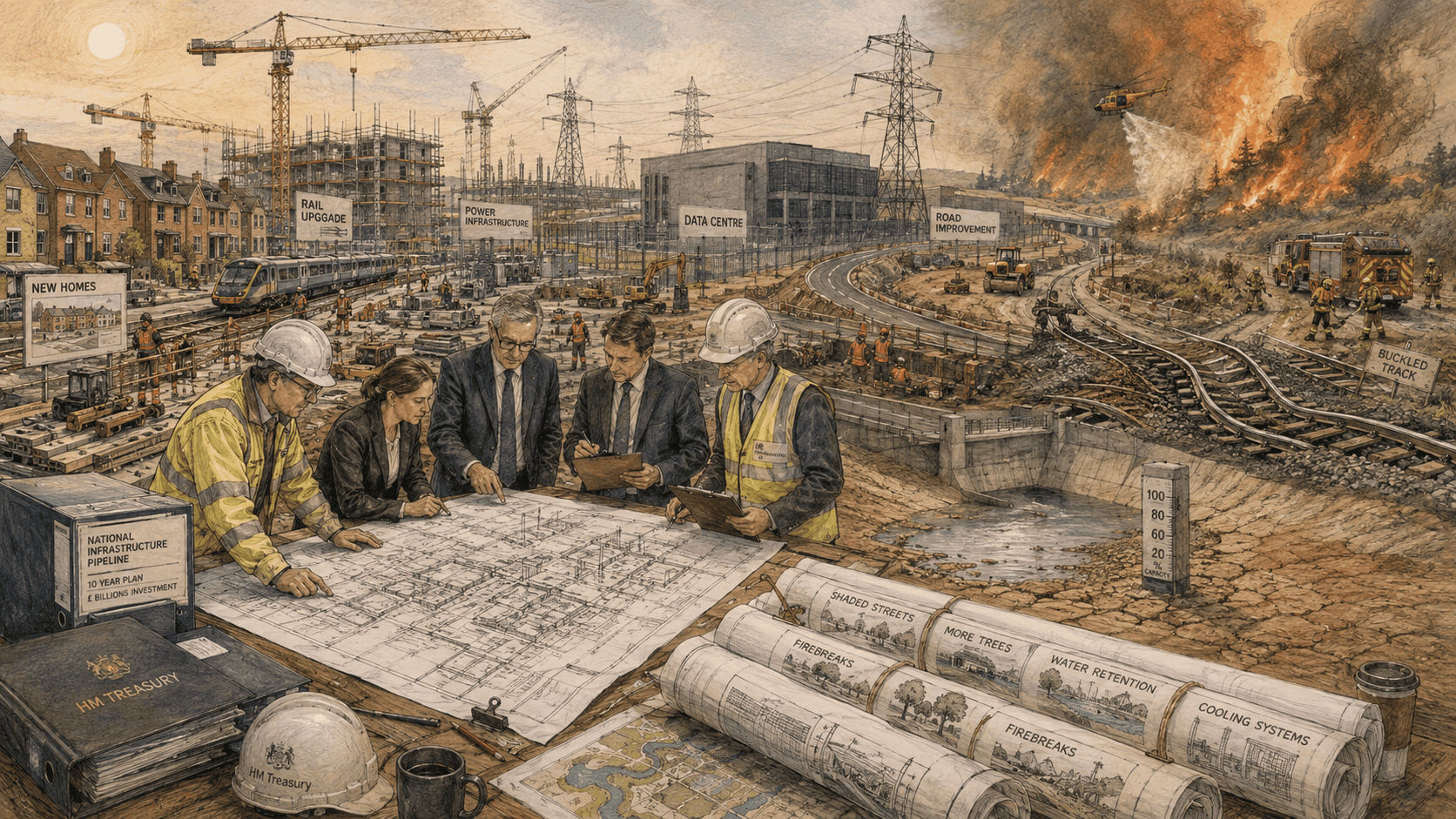
Britain is not watching from safety. It is in its own “firewave”, with blazes from the Cairngorms to the Suffolk coast and nearly half of England facing exceptionally serious drought.
This is the new climate politics: not distant targets, but smoke, evacuations, broken infrastructure and emergency response under strain.
Net zero is not enough
Governments have focused heavily on emissions reduction – rightly, but too narrowly.
Chatham House argues that even if the world decarbonised much faster, societies would still need to prepare for impacts already baked into the system. Extreme heat, water stress, wildfire risk and food supply shocks are no longer future scenarios.
They are happening now.
That makes adaptation the missing half of climate policy. Without it, net zero becomes a promise about the future while today’s systems fail in the heat.
Britain’s delivery gap is exposed
The UK has made progress in assessing climate risks. The problem is implementation.
Overheating, water resilience and wildfire preparedness remain underdeveloped. The country can produce assessments, strategies and warnings, but the summer’s fires show how far it still is from practical readiness.
That is the familiar policy failure: Britain knows the risk before it builds the defences.
Adaptation is economic policy
The Chatham House argument is that adaptation must stop being treated as environmental housekeeping.
Flood defences, emergency planning and ecosystem protection matter. But real resilience means changing how Britain manages land, designs cities, builds infrastructure and allocates public money.
Peatland restoration can help retain moisture and reduce burning. Vegetation management can cut fire risk. Cities need more trees, green space and heat-resilient buildings. Schools, hospitals and care homes need cooling solutions before heat turns into a public-health crisis.
This is not green decoration. It is economic survival planning.
The Treasury must stop treating resilience as an afterthought
The hard part is money.
Adaptation needs to be built into decisions on transport, energy, housing, water infrastructure and even new technology plans such as sovereign AI expansion. If data centres, roads, railways, power networks and homes are built without climate resilience, Britain will pay later through disruption, insurance losses and emergency repairs.
Chatham House is clear: the cost is significant, but the cost of inaction will likely be far higher.
That is the budgetary reality Burnham cannot dodge.
Climate risk crosses borders
The commentary also warns that adaptation cannot stop at the UK coastline.
A less resilient world is a less stable world. Water scarcity, food shocks, ecosystem collapse and extreme weather can fuel migration pressure, instability, trade disruption and security risks. That makes climate adaptation a foreign-policy issue, not just a domestic repair job.
The UK can use the G7, Commonwealth ties and bilateral partnerships to push adaptation finance, water diplomacy and ecosystem restoration. But that requires more than speeches.
It requires delivery abroad as well as at home.
The weakness Europe still underestimates
Europe has spent years arguing about emissions targets, carbon pricing and clean energy. Those fights matter. But the fires show another vulnerability: the continent is still poorly prepared for the climate impacts already arriving.
Emergency services, insurers, schools, transport systems, agriculture and public health are being tested by conditions they were not designed to handle.
The danger is not only hotter weather. It is governments discovering that their infrastructure, budgets and public services cannot cope with the new normal.
The stark truth: Climate adaptation is now national security
Chatham House’s message is simple: Europe’s summer of fire should end the illusion that adaptation is optional.
Burnham’s government can keep climate resilience in strategy documents and watch disasters expose the gap. Or it can make adaptation a core test of every major economic and foreign-policy decision.
Britain does not just need to cut emissions.
It needs to survive the climate it already has.