
World Center for Strategic Studies
From closed analysis to public debate
- MONTH
- YEAR

Europe’s Carbon Credit Gamble: Brussels Risks Buying Hot Air
Europe is reopening the door to international carbon credits as part of its 2040 climate target. The Bruegel policy brief treats this as a potentially useful tool – but one loaded with old traps that could shred the EU’s climate credibility if handled badly.
The logic is tempting. If emissions can be cut more cheaply abroad than inside Europe, the EU can lower transition costs while financing decarbonisation in poorer economies. But the danger is just as clear: Europe could hit its target on paper while the atmosphere gets no real benefit.
Bruegel’s warning is sober but sharp. Carbon trading can be a strategic lever. It can also become an accounting trick.
The 5 percent loophole
The EU has accepted that up to 5 percent of the emissions reduction effort for its 2040 target may come from international carbon credits.
That may sound small. It is not.
Bruegel estimates this could represent at least 236 million tonnes of CO₂ equivalent between 2036 and 2040 – roughly the scale of France’s annual emissions. Depending on the carbon price, the market could be worth between €7 billion and €24 billion.
That is a serious pot of money. It is also a serious temptation for weak credits, soft rules and political shortcuts.
Europe has been burned before
This is not Brussels’ first carbon-credit experiment. Under the old Kyoto system, companies used international credits to offset around 1.5 billion tonnes of CO₂ equivalent under the EU emissions trading system between 2008 and 2012.
The result was not clean glory. It helped weaken the carbon price signal and reduced pressure for domestic decarbonisation.
That history matters because the same political instinct is returning: use cheaper reductions abroad to make Europe’s own climate targets easier to swallow at home.
The risk is that Europe imports comfort instead of cuts.
The fake-clean problem
A carbon credit only works if the reduction is real, additional, permanent and counted once.
That is where the trouble starts. Measuring emissions that never happened is difficult. Proving a project would not have happened without credit money is even harder. Forests can burn. Soil carbon can disappear. Renewable projects may have gone ahead anyway. The same reduction can be claimed by both buyer and seller if accounting fails.
Fraud sits across the whole system, from inflated baselines to favourable methodologies and weak disclosure.
In plain English: the credit may look clean while the emissions are still there.
Paris rules are not a magic shield
The Paris Agreement’s Article 6 mechanisms are meant to bring order to international carbon trading. Article 6.2 allows country-to-country trading, while Article 6.4 creates a UN-supervised market.
Bruegel’s point is that these mechanisms are a starting point, not a guarantee.
Under bilateral deals, standards can differ and independent supervision may be limited. Even under the UN route, old Kyoto-era projects and methodologies could carry over, including some that were already criticised for weak additionality.
A new label does not automatically mean a cleaner market.
Strict rules mean fewer credits
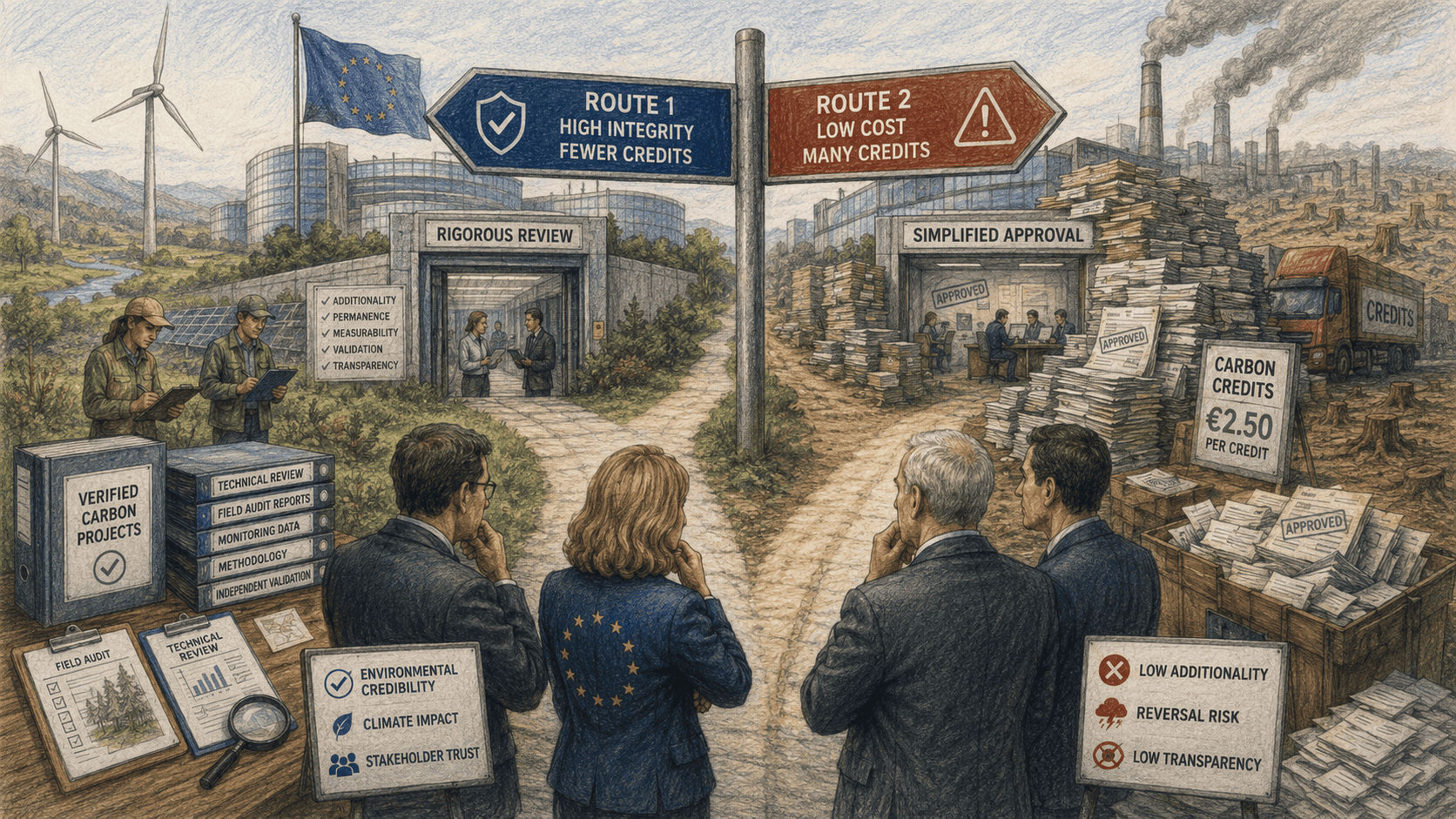
Here is the policy trap. If Europe demands very high standards, the supply of acceptable credits may be limited, slow and expensive. If it accepts looser standards, credits may be cheap and plentiful – but climate value may collapse.
That is the ugly trade-off.
Brussels wants carbon credits to ease the cost of the transition. But the cheaper the shortcut becomes, the greater the danger that it stops being a real cut and becomes a political escape hatch.
The Global South angle matters
Done properly, international carbon trading could move serious money into emissions reductions where investment is badly needed.
That could support cleaner infrastructure, green industry and climate cooperation beyond Europe. It could also help show that the EU’s green agenda is not just a fortress policy built around CBAM and domestic regulation.
But if the system is designed badly, it could repeat the worst donor-style pattern: Europe buys offsets, poorer countries carry the projects, and credibility evaporates when the numbers are challenged.
The last word: Cheap cuts can become costly lies
Bruegel is not saying international carbon credits are useless. It is saying Europe must stop pretending they are automatically credible just because they sit inside a Paris Agreement framework.
The EU’s 2040 target will be judged not only by the numbers Brussels reports, but by whether emissions actually fall.
If Europe lets weak credits into the system, it may claim progress while weakening the whole point of climate policy.
That would be a very expensive way to buy hot air.