World Center for Strategic Studies
From closed analysis to public debate
- MONTH
- YEAR

Italy’s Ukraine Fault Line: Meloni’s Pro-Kyiv Line Starts To Crack
Ukraine is becoming the issue that could split Italy’s next election wide open. The Politico report shows Giorgia Meloni under growing pressure as support for Kyiv turns from a foreign-policy commitment into a domestic political weapon.
For most of the war, Meloni kept Italy firmly inside the Euro-Atlantic camp. She backed Ukraine, supported sanctions and reassured Brussels and Washington that Rome would not become the weak link. But the next campaign is changing the calculation.
War fatigue, defence costs, Trump’s return, Salvini’s ambiguity and Conte’s anti-rearmament message are all converging. Italy’s Ukraine policy is no longer just about Moscow and Kyiv. It is about votes, budgets and who owns the national mood.
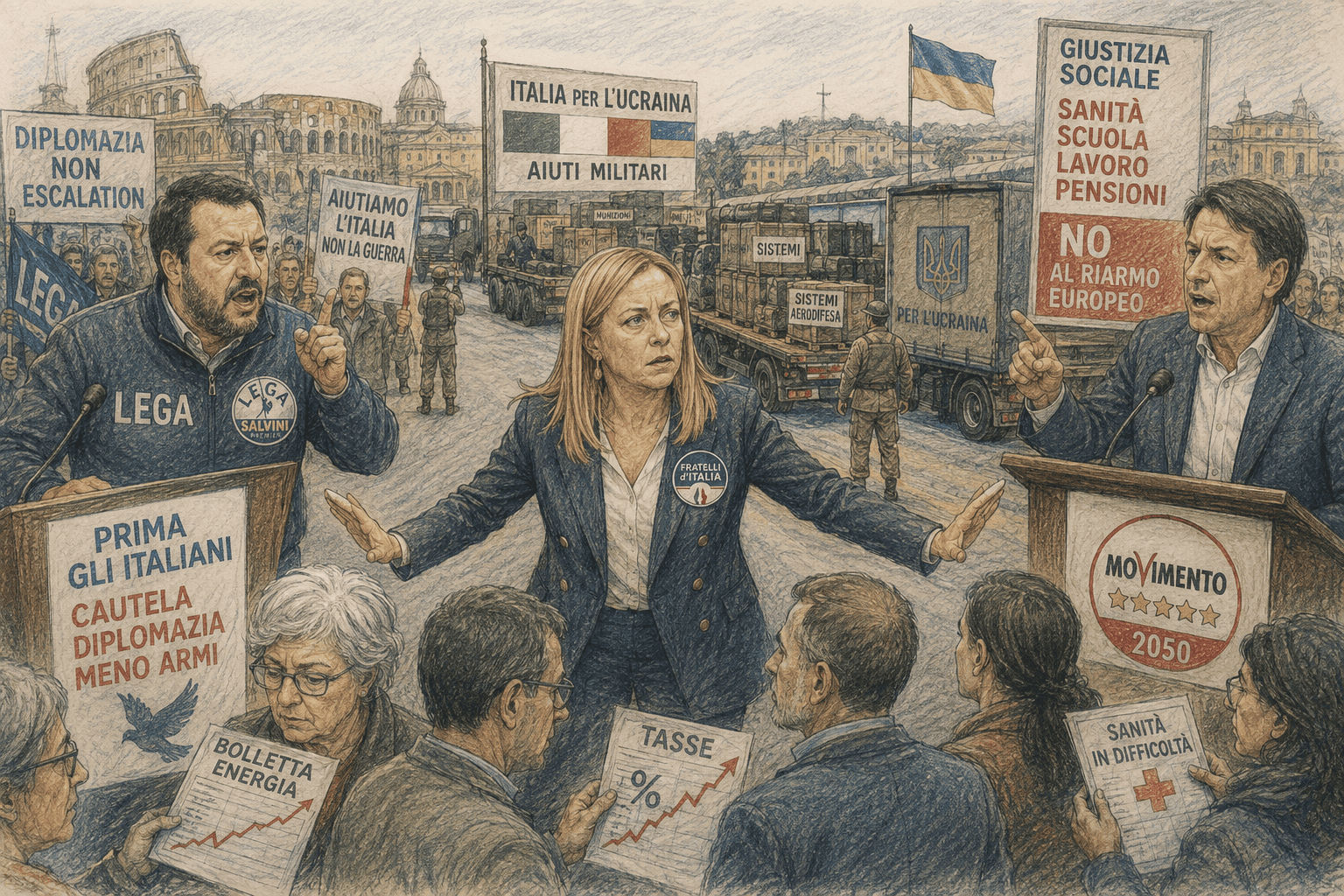
Meloni’s balancing act is getting harder
Meloni has built her European credibility on one central promise: Italy may have a hard-right government, but it will not betray Ukraine.
That promise mattered. It calmed allies who feared Rome might drift towards the old pro-Russian instincts of parts of the Italian right. It also helped Meloni present herself as a serious Atlanticist leader rather than another populist agitator.
Now that line is under strain.
With an election approaching, keeping Kyiv support steady means absorbing attacks from both the opposition and her own political camp.
Salvini smells an opening
Matteo Salvini’s League has long been the awkward partner in Meloni’s coalition on Russia and Ukraine.
The League formally supports the government line, but its rhetoric is often softer on Moscow, more sceptical of arms deliveries and more eager to talk about diplomacy. That gives Salvini space to court voters tired of the war without directly collapsing the coalition.
For Meloni, this is dangerous. If she looks too hardline on Ukraine, Salvini can pose as the voice of Italian caution. If she softens, she risks losing credibility with NATO, the EU and Washington.
The coalition holds – but the pressure is obvious.
Conte attacks the rearmament agenda
Giuseppe Conte and the Five Star Movement are turning Ukraine and European defence spending into a campaign issue.
Their argument is simple and politically potent: Italy should not be dragged into an endless war economy while households face economic pressure and public services remain strained. Conte’s criticism of Europe’s “race to rearm” gives anti-war and anti-establishment voters a clear home.
That does not mean Italians are pro-Russian. It means many are weary, anxious and unconvinced that more weapons and more defence spending will make their lives safer or better.
That is exactly the space populists exploit.
Europe fears the Italian wobble
Rome matters because Italy is not a side player. It is a G7 country, a core EU member, a major NATO ally and a key Mediterranean power.
If Italy’s Ukraine consensus weakens, the damage would spread beyond Rome. It would encourage other sceptical forces across Europe, complicate EU sanctions, slow military aid debates and reinforce Moscow’s hope that Western unity will crack through elections rather than battlefield victory.
Meloni knows this. Brussels knows it too.
That is why the Italian election could become a test of Europe’s staying power.
Trump changes the equation
Donald Trump’s return makes Meloni’s position even more delicate.
She wants good relations with Washington, and she has worked hard to avoid being treated as an unreliable European radical. But if Trump pushes for a different Ukraine settlement or pressures Europeans to carry more of the burden, Meloni could be trapped between loyalty to Kyiv, loyalty to NATO and loyalty to her ideological friends across the Atlantic.
The result is a strategic headache dressed up as an election issue.
Italy’s right may admire Trump. But Trump’s Ukraine policy could make Meloni’s life harder, not easier.
War fatigue is now political fuel
The longer the war continues, the easier it becomes for parties to question the cost.
Military aid, sanctions, refugee support, energy disruption and higher defence budgets all feed into the same public anxiety. Opposition forces can frame Ukraine support as an elite priority disconnected from Italian hardship.
That is not always fair. But it is politically effective.
For Meloni, the danger is that backing Ukraine starts to look like defending Brussels’ agenda rather than Italy’s interest.
The weakness Russia will exploit
Moscow does not need Italy to switch sides openly. It only needs doubt, delay and division.
If Italian parties turn Ukraine into a campaign wedge, Russia gains another example of Western fatigue. If Rome slows decisions or demands softer language, EU unity becomes harder to maintain. If voters punish pro-Kyiv leaders, other governments will notice.
That is the real battlefield inside European politics: not whether support disappears overnight, but whether it becomes more hesitant, conditional and exhausted.
The warning sign: Ukraine is becoming an election weapon
Politico’s report shows Italy moving into a dangerous phase. The old consensus behind Ukraine is no longer politically cost-free.
Meloni still stands with Kyiv, but she now has to defend that line against coalition rivals, populist opposition, public fatigue and a changing Washington.
Europe’s support for Ukraine depends not only on weapons, budgets and summits.
It depends on elections – and Italy may be one of the next places where that unity is tested.