World Center for Strategic Studies
From closed analysis to public debate
- MONTH
- YEAR

Europe’s Nuclear Comeback: Big Promise, Bigger Delivery Problem
Nuclear power is back in Brussels’ good books – but the CEPS report warns that political fashion will not build reactors. After years of energy shocks, Russian pressure, expensive gas and industrial anxiety, the EU is again looking at nuclear as a homegrown source of low-carbon, dispatchable power.
The attraction is obvious. Nuclear can support energy security, stabilise a renewables-heavy grid and give industry firm electricity without relying on fossil fuels or foreign supply chains. But the report’s message is unforgiving: Europe cannot simply talk its way into a nuclear revival.
The continent has lost time, skills, supply chains and investor confidence. Now it wants a comeback in one of the hardest industries on earth.
The old dream returns
Europe has been here before. Nuclear once sat at the heart of European industrial ambition, backed by the Euratom Treaty and driven by the energy insecurity of the 1970s.
Then the mood turned. Three Mile Island, Chernobyl and Fukushima hardened public opposition, while national phase-outs, policy reversals and decades of stop-start politics hollowed out Europe’s nuclear base.
Now energy security has pushed the issue back onto the agenda. The EU’s latest nuclear thinking reflects a colder world where cheap imported energy can no longer be taken for granted.
But nostalgia is not a construction plan.
Europe split itself
The biggest political problem remains division between member states.
France, Czechia, Poland and other pro-nuclear governments want nuclear treated fairly alongside other low-carbon technologies. Anti-nuclear or sceptical states fear it could divert money and political attention from renewables.
That split has poisoned EU policy for years. Nuclear is present in climate and energy frameworks, but often awkwardly, partially or under contested labels. The result is not a clear European nuclear strategy, but a fragile compromise that satisfies nobody fully.
Brussels talks about technology neutrality. Member states still fight old wars.
The economics are ugly
New nuclear plants are expensive, slow and financially risky.
CEPS is clear that nuclear struggles against renewables on basic levelised cost comparisons. Its defenders argue that this misses its system value: reliability, dispatchable generation, grid stability and lower wider balancing costs in a power system packed with variable wind and solar.
That argument matters. But it does not erase the bankability problem.
Investors see long construction periods, huge upfront capital needs, price volatility and the risk of delays blowing up the entire business case. Without public de-risking, contracts for difference, guarantees or long-term offtake deals, most new projects will struggle to move.
The market alone will not rescue nuclear.
Europe forgot how to build
The harshest weakness is delivery.
European nuclear projects carry a legacy of delays, cost overruns, weakened supply chains and shrinking specialist workforces. Only a few new reactors have been built in Europe since the 1990s, and many became cautionary tales rather than confidence boosters.
That matters because construction risk is not a side issue. It directly raises financing costs, scares investors and undermines political support.
If Europe cannot build on time and at credible cost, the nuclear revival will collapse into another expensive slogan.
Supply chains are too thin
A serious nuclear comeback requires more than one reactor design and a political press release.
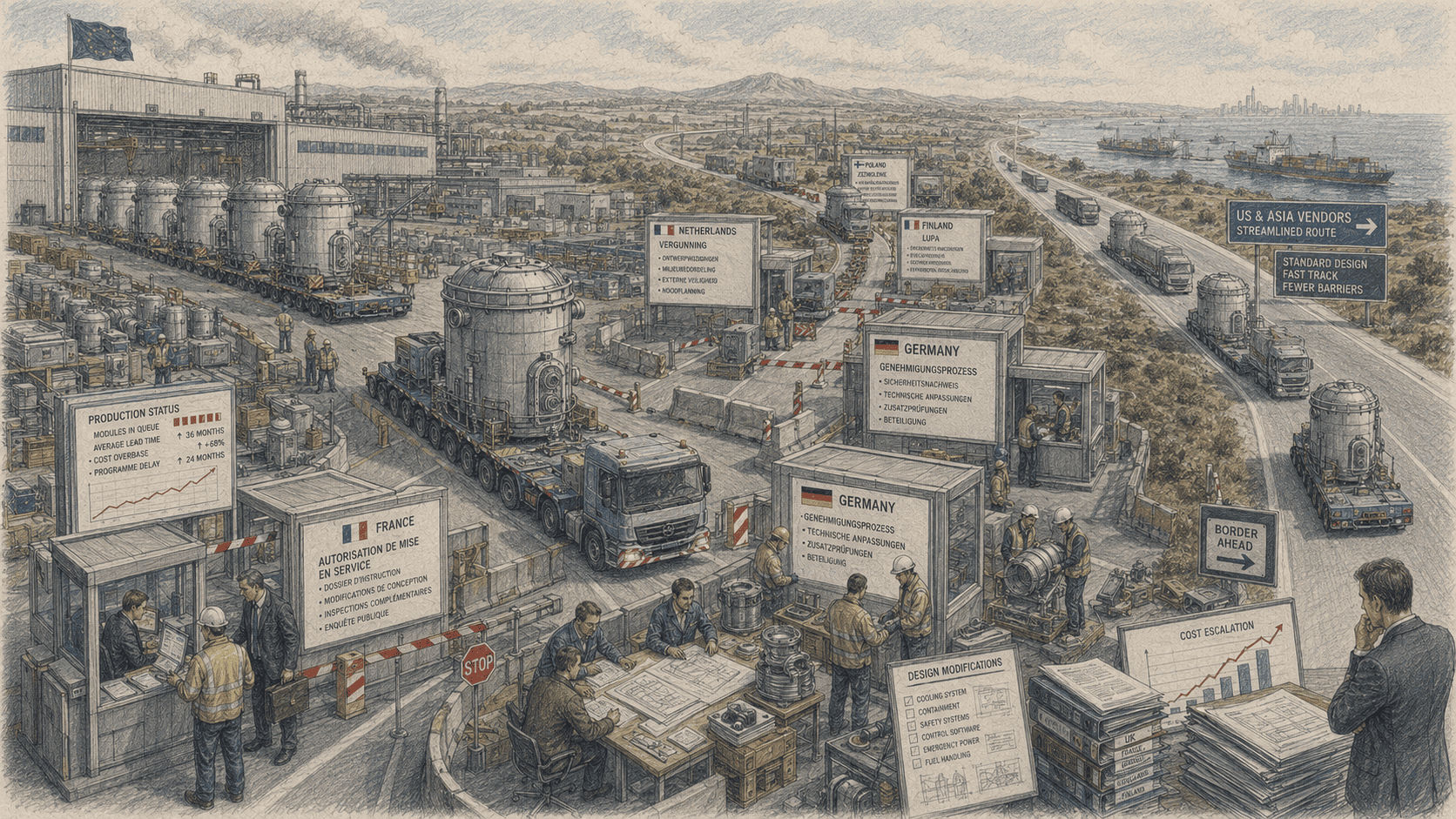
Europe needs manufacturing capacity, certified components, engineering expertise, skilled labour, fuel-cycle resilience, project-management discipline and a stronger vendor base. CEPS warns that limited competition among engineering and construction suppliers is already a bankability problem.
There is also a sovereignty risk. Non-EU technology vendors are increasingly active in both large-scale reactors and small modular reactors.
That raises an awkward question: is Europe trying to reduce energy dependence by importing the next generation of nuclear technology?
SMRs are not magic
Small modular reactors are the new favourite in Brussels, backed by the EU SMR alliance and a 2026 strategy. They promise faster deployment, modular production, industrial heat, district heating and flexible electricity for industrial clusters.
The trouble is that the promise remains largely unproven.
Many near-term SMRs still need first-of-a-kind deployment to show real costs and timelines. More advanced designs are further from commercial readiness. National licensing systems remain fragmented, which threatens the whole logic of standardised serial production.
SMRs may help. But they are not a shortcut around Europe’s industrial weakness.
The grid is changing under nuclear’s feet
The report also warns that nuclear must adapt to a power system increasingly dominated by variable renewables.
Traditional nuclear economics depend on high-capacity baseload operation. But future electricity markets may feature more low or negative price periods, more flexibility needs and more pressure on plants to follow demand.
Nuclear can technically load-follow in many cases, but the business model becomes more complicated. Its value must be recognised not only through electricity sales, but through long-term contracts, system services and industrial demand.
Europe wants nuclear stability inside a market built for volatility. That clash still needs solving.
The uncomfortable truth: Nuclear revival needs more than applause
CEPS does not dismiss nuclear. It says the opposite: nuclear may have a real role in Europe’s energy security, decarbonisation and industrial competitiveness.
But the report strips away the easy rhetoric. Political support is necessary, not sufficient. Europe must rebuild supply chains, train workers, stabilise regulation, de-risk finance, reform licensing, coordinate member states and prove it can deliver projects without endless overruns.
That is a huge test for a continent already struggling with slow infrastructure, divided politics and weak industrial execution.
Europe wants nuclear back.
Now it has to prove it can actually build it.