World Center for Strategic Studies
From closed analysis to public debate

- MONTH
- YEAR

NATO’s Spending Boom: Big Numbers, Bigger Doubts
NATO’s European members are finally spending serious money on defence. The IISS analysis says the rise is real, rapid and historically significant: European NATO budgets are expected to climb by almost 10 percent in 2026, reaching around $639 billion. Since Russia’s full-scale invasion of Ukraine, nominal spending has surged by more than 90 percent.
That should be good news. But the paper warns against celebrating too quickly. The real question is not whether Europe is spending more. It is whether all that money is turning into forces, weapons, stockpiles, production lines and deployable combat power.
Europe has learned to hit bigger numbers. It still has to prove it can build real military strength.
The cash is finally moving
After years of American complaints and European excuses, the defence-spending curve has turned sharply upwards.
Germany is the most dramatic case, with major real-terms increases across 2024, 2025 and 2026. Across European NATO, more than a third of defence spending is now going into procurement and research and development – a sign that allies are trying to rebuild forces rather than just cover salaries and routine running costs.
That matters because Europe’s armed forces have been hollowed out by decades of underinvestment.
The money is late. But it is finally arriving.
The 5 percent target changes the game
NATO’s new spending framework has made the debate much more complicated.
The headline goal is no longer just 2 percent of GDP. Allies are now working towards 3.5 percent for core defence spending, plus another 1.5 percent for wider defence- and security-related investment by 2035.
That gives governments a bigger political target – and a bigger accounting temptation.
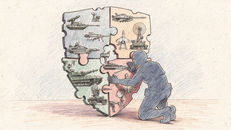
The danger is obvious: as the definition of defence spending expands, the numbers may start looking stronger than the actual military capability behind them.
Accounting fog is rolling in
IISS warns that comparison is getting harder because countries count things differently.
Some spending clearly buys military power: ammunition, equipment, air defence, ships, aircraft, command systems, training and readiness. Other categories are more ambiguous: intelligence, cyber resilience, civil protection, infrastructure, border security and wider national-security programmes.
Some of these are genuinely important. But once they are folded into NATO spending targets, politicians can blur the line between hard defence and broader security housekeeping.
That is how a spending pledge becomes a statistical battlefield.
More money does not mean more power
The biggest warning is about output.
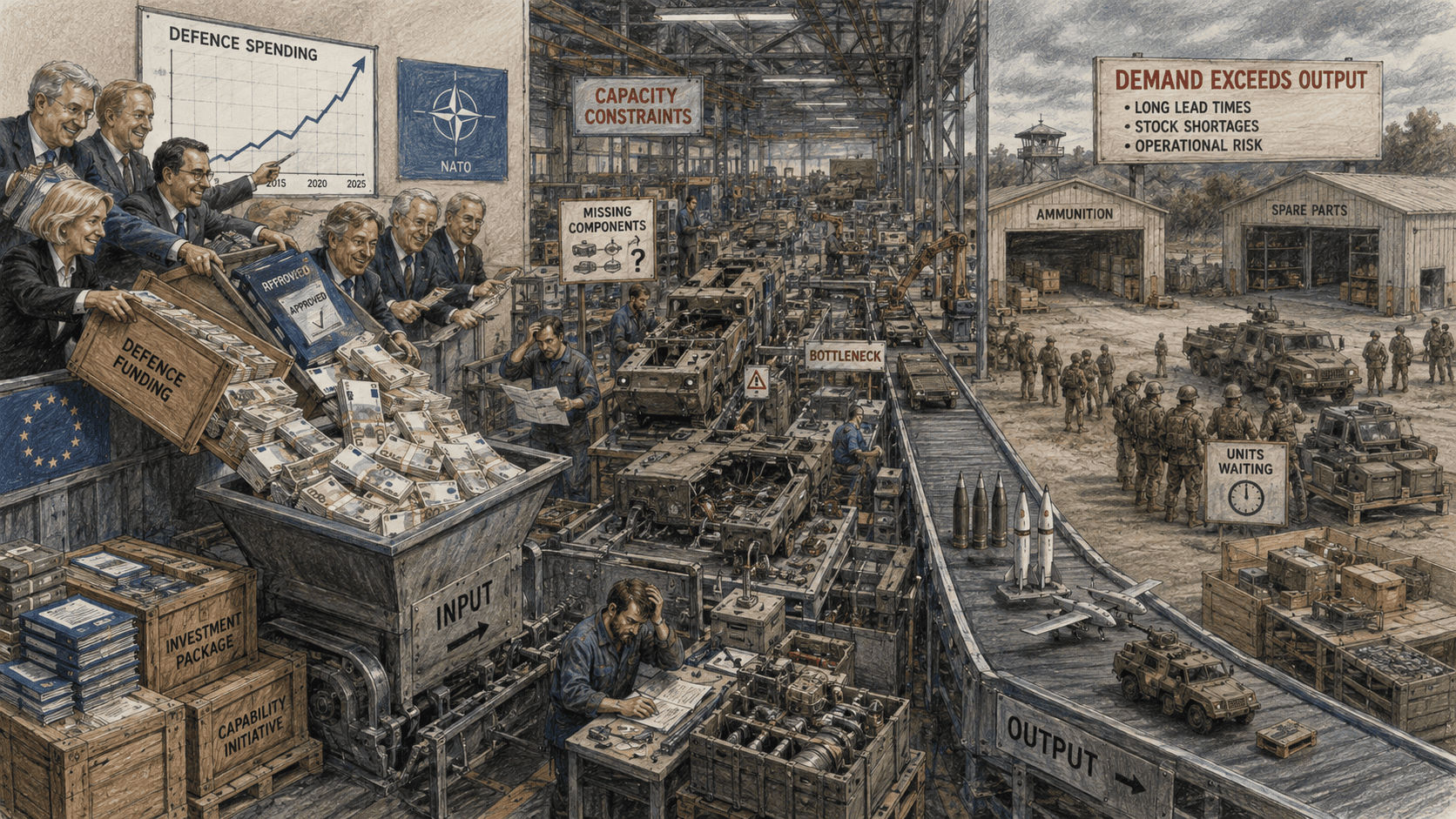
Europe can announce higher budgets, but if procurement remains slow, industry cannot scale, contracts are delayed and weapons arrive too late, the spending boom will disappoint. Defence budgets only matter if they produce usable forces.
Ukraine has shown what modern war consumes: shells, air defence missiles, drones, spare parts, electronic warfare systems, logistics and replacements at brutal speed.
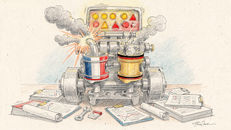
Europe’s problem is not only how much it spends. It is whether the system can absorb the money and turn it into production.
Industry is still the bottleneck
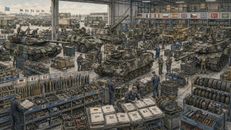
The defence-industrial base is now under pressure to expand after decades of low-volume orders.
Factories need long-term demand signals, skilled workers, secure supply chains and predictable contracts before they invest in new capacity. Governments want faster output, but industry will not gamble billions if political commitments look temporary or fragmented.
This is where Europe’s old defence disease returns: many countries, many requirements, many national priorities, too little scale.
Without industrial discipline, higher budgets will leak into delays, duplication and price inflation.
Washington will still ask hard questions
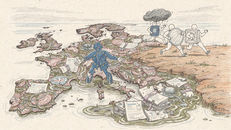
The spending surge is partly a response to American pressure. European allies know they can no longer assume the United States will quietly carry the burden while they argue over budgets.
But bigger European numbers will not automatically silence Washington.
US officials will look at capability, not just percentages. Can Europe move forces quickly? Can it sustain combat? Can it replace US enablers? Can it defend the eastern flank? Can it keep Ukraine supplied while rebuilding its own stockpiles?
If the answer is weak, the political fight over burden-sharing will continue.
The weakness rivals will exploit
Russia will not be deterred by spreadsheets.
It will judge NATO by readiness, ammunition depth, air defence coverage, command capacity, industrial mobilisation and political will. If the spending surge produces impressive budget lines but limited operational change, the deterrent effect will be weaker than leaders claim.
That is the danger behind the noise.
Europe may look stronger on paper before it becomes stronger in practice.
The reality check: Defence spending is not defence power
The IISS analysis cuts through the celebration. Europe is spending more, and that is necessary. But the hard test is whether money becomes capability before the next crisis.
Targets can focus minds. They can also encourage creative accounting. Budgets can rise. Forces can still remain short of ammunition, readiness and mass.
NATO’s European allies have finally accepted that defence costs real money.
Now comes the harder part: proving the money can buy power fast enough.