World Center for Strategic Studies
From closed analysis to public debate

- MONTH
- YEAR

Europe’s Deep-Strike Gap: Drones May Be The Cheap Fix Brussels Cannot Ignore
Europe has a serious long-range strike problem – and its high-end answer will not arrive fast enough. The Geopolitical Monitor assessment argues that Europe’s indigenous deep-strike systems are unlikely to appear in meaningful numbers before 2028, with the most capable platforms pushed towards the early 2030s.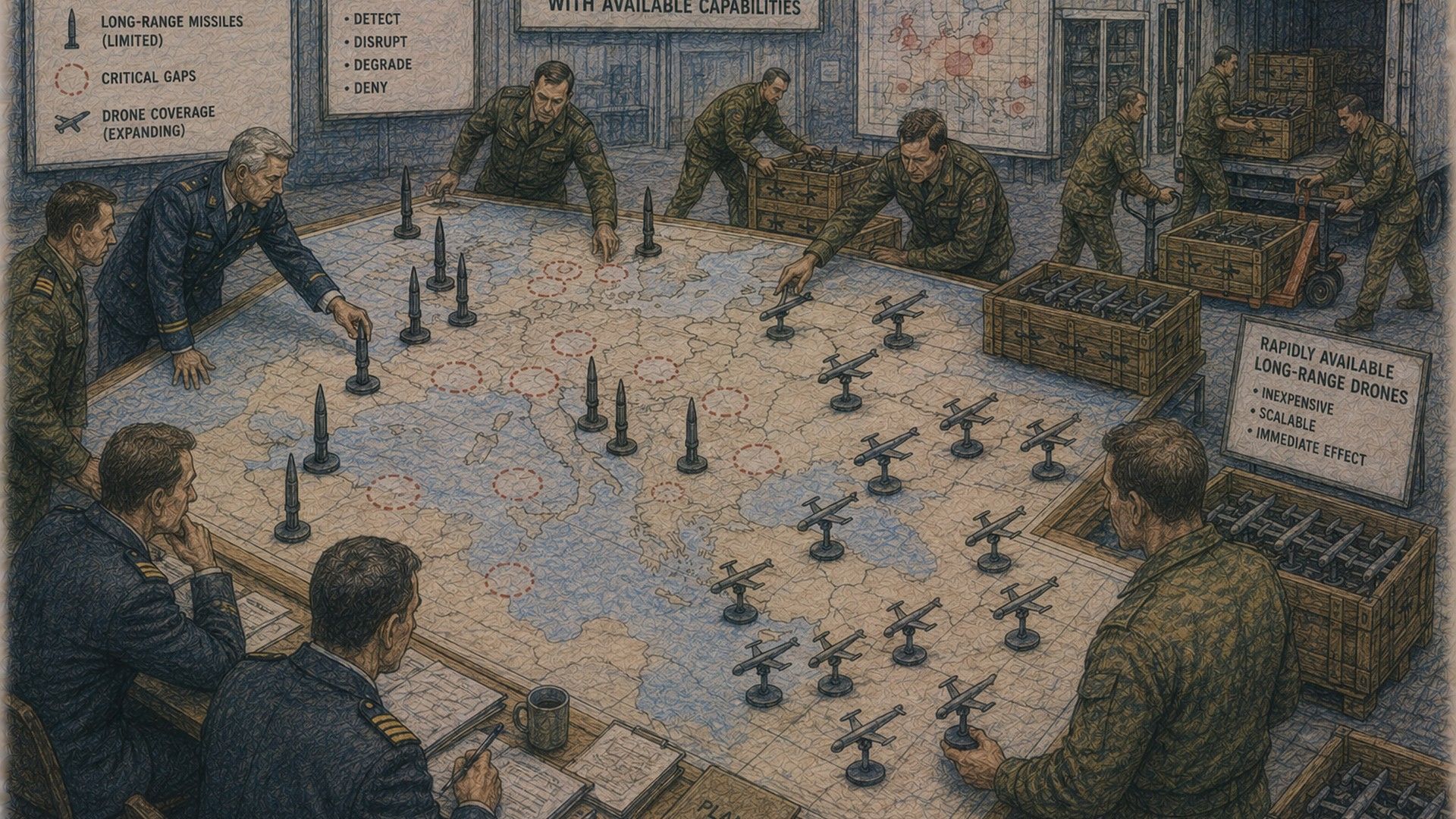
That leaves a dangerous gap at the worst possible moment. Russia has shown that deep strikes can shape war far beyond the front line. Ukraine has shown that cheap long-range drones can hit strategic targets hundreds or even thousands of kilometres away. Europe, meanwhile, is still trying to build the expensive missile arsenal it should have started years ago.
The blunt question is whether drones can keep Europe alive in the gap between political ambition and real military capability.
Europe is late again
The core problem is timing. European militaries want deep-strike capability, but their own programmes are slow, expensive and still years away from scale.
That matters because deep strike is no longer a luxury. It is central to deterrence. Without the ability to hit enemy air bases, logistics hubs, command nodes and energy infrastructure at long range, European forces remain too dependent on the United States for the hardest parts of modern war.
The paper’s warning is stark: Europe cannot simply wait for perfect systems to arrive in the 2030s.
Ukraine built under fire
Ukraine offers the clearest proof of concept. Before 2022, it did not have a serious long-range drone industry. Four years later, it has created a domestic arsenal capable of striking deep into Russia, hitting targets at ranges reported up to 1,750 kilometres.
This was not born from luxury. It came from necessity: Western missile shortages, restrictions on donated weapons and the need to hit strategic targets far behind Russian lines.
That ugly pressure forced speed, improvisation and mass production. Europe should be studying the lesson hard.
Cheap drones are changing the maths
The most uncomfortable point for Europe’s defence planners is cost. Traditional cruise missiles are powerful but expensive, slow to produce and difficult to stockpile in large numbers.
Ukraine’s long-range drones show a different model. Platforms such as the Liutyi and FP-1 can provide strategic reach at far lower unit costs than many missile systems. They are not perfect substitutes for cruise missiles, but they can create volume, pressure and uncertainty at a price Europe can realistically scale.
That is the attraction. Drones may not solve every deep-strike problem, but they can fill the gap faster than prestige weapons.
Mass matters more than elegance
The war in Ukraine has hammered home a brutal lesson: exquisite weapons are not enough if arsenals run dry.
Europe’s defence industry remains too often built around small batches, long timelines and polished systems. That model struggles in a war of attrition where thousands of platforms may be needed, not dozens.
Long-range drones offer a way to build quantity into European deterrence. They can overload defences, complicate enemy planning and threaten strategic depth without waiting for every next-generation missile programme to mature.
The delivery test is brutal
The real challenge is whether Europe can copy Ukraine’s speed without Ukraine’s wartime urgency.
European defence procurement is slow, fragmented and cautious. National industries compete. Regulations slow decisions. Governments demand sovereignty while underfunding production. That is a poor recipe for rapid drone scaling.
If Europe treats long-range drones like another prestige procurement project, it will miss the point. The advantage lies in fast iteration, cheap production, operational learning and mass.
Washington still holds the safety net
The deep-strike gap also exposes Europe’s continued dependence on America. For decades, NATO’s hardest strike capabilities were heavily underwritten by US platforms, missiles and intelligence support.
That arrangement is becoming politically riskier. If Washington’s focus shifts, or if a future US administration demands Europe carry more of the burden, European militaries could find themselves exposed.
Drones are not a full escape from US dependence. But they are one of the few tools Europe could build quickly enough to reduce the most dangerous gap.
The weakness rivals will exploit
Russia will not wait for Europe’s procurement calendars. Neither will any other adversary watching the continent’s slow rearmament.
A Europe without credible deep-strike mass risks looking vulnerable, especially if its most ambitious missile systems remain years away. Deterrence depends not only on plans, but on weapons available now.
The danger is that Europe announces capability while lacking stockpiles, production lines and operational doctrine.
The hard lesson: Perfect weapons arrive too late
The Geopolitical Monitor assessment does not argue that drones should replace missiles. It argues that Europe needs something credible before its full deep-strike architecture arrives.
That is the harsh reality. Drones are cheaper, faster and more scalable than many traditional systems. They can plug part of the gap, give European forces reach and reduce dependence on US firepower.
But only if Europe moves with urgency.
Otherwise, the continent risks spending the rest of the decade admiring future capabilities while today’s battlefield exposes what it still cannot hit.