World Center for Strategic Studies
From closed analysis to public debate

- MONTH
- YEAR

Channel Crackdown: Europe Throws More Police At A Border It Still Cannot Control
The EU is stepping deeper into the Channel migration fight, promising more staff, more surveillance and tighter co-operation with Britain and France. The RFI report shows Brussels trying to turn one of Europe’s most politically toxic routes into a managed security operation. 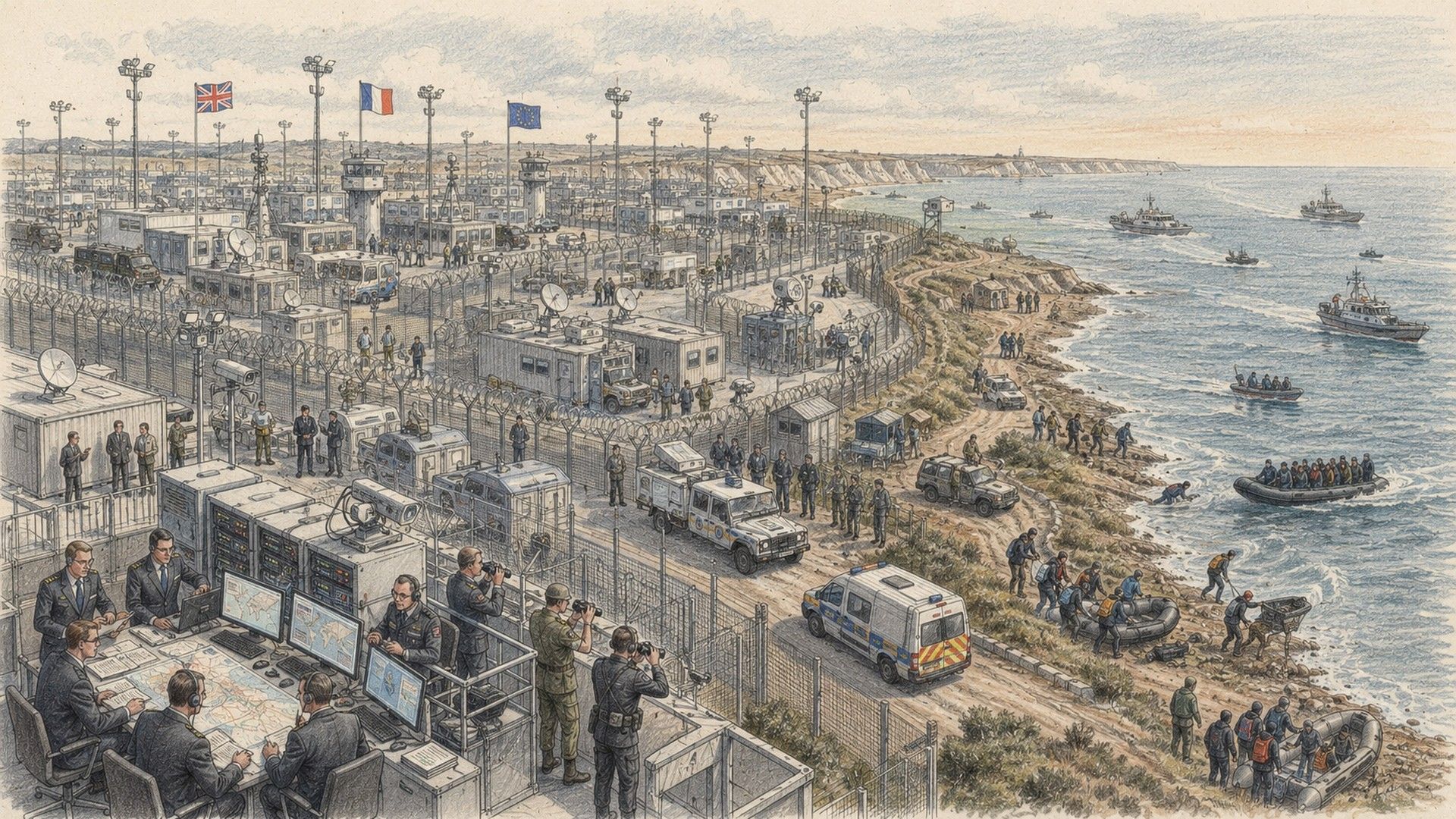
But the move also exposes the ugly truth behind the headlines. Small-boat crossings have fallen this year, yet the route remains dangerous, profitable for smugglers and politically explosive on both sides of the Channel. Every new patrol, camera and intelligence team is also an admission that previous efforts failed to shut the route down.
Europe is not celebrating control. It is scaling up containment.
Brussels enters the beach war
The Commission’s Channel plan focuses on three fronts: stronger migration diplomacy with countries of origin and transit, tougher disruption of smuggling networks, and reinforced border management along the route.
That means more operational support from EU agencies, closer work with France, Belgium and the UK, and heavier use of surveillance, data-sharing and enforcement tools.
The message is clear. Brussels no longer treats the Channel as a British-French headache alone. It sees the route as a European security and migration problem spilling across Schengen, public order systems and domestic politics.
The numbers still hurt
The EU says illegal crossings out of the bloc along the Channel route are down sharply so far in 2026. That gives officials something to point to.
But the scale remains grim. Nearly 64,000 attempted crossings were recorded in 2025, and small boats continue to test police, coastguards and asylum systems. Even when departures are prevented, migrants and smugglers adjust routes, launch tactics and timing.
That is the core failure. Enforcement can reduce pressure, but it has not broken the business model.
France wants help – and cover
Paris has pushed hard to make Channel crossings a European issue rather than a bilateral row with London.
That matters politically. France does not want to be seen simply as Britain’s hired border guard, especially while French coastal communities carry the pressure of camps, police deployments and smuggler violence.
By bringing Brussels into the fight, Paris gains money, legitimacy and shared responsibility. It also spreads the blame if the crossings keep coming.
Britain left the EU – but not the problem
The Channel crisis also exposes a brutal Brexit irony. Britain left the EU promising restored border control, but still depends heavily on French policing, EU co-operation and cross-border data sharing to manage one of its most visible migration pressures.
London can toughen rhetoric at home. It can fund patrols in France. It can demand results.
But it cannot stop the route alone. Geography has made Brexit’s border promise collide with European reality.
Smugglers adapt faster than systems
The plan targets organised criminal networks, their logistics, money flows and equipment supplies.
That is sensible, but difficult. Smuggling groups are flexible, decentralised and quick to exploit gaps in enforcement. When one launch site is blocked, another becomes attractive. When boats are seized, lower-quality replacements appear. When coastal patrols increase, “taxi boat” tactics move migrants offshore.
Europe’s enforcement machine is large, expensive and slow. The gangs it is chasing are smaller, faster and harder to pin down.
Human rights pressure will grow
The tougher security push will not land without criticism. More policing, more detention, more surveillance and more force on beaches raise serious concerns from rights groups and refugee charities.
The political direction is clear across Europe: governments want visible control, faster returns and fewer irregular arrivals. But the humanitarian cost is also growing clearer, especially when people are pushed into more dangerous routes or trapped between police pressure and smuggler exploitation.
The Channel is becoming both a security theatre and a moral test.
Process is replacing strategy
The EU can add agencies, co-ordination meetings, action plans and operational support. But the deeper problem remains unresolved: Europe still lacks a migration system that combines credible border control, fast asylum decisions, returns that work and legal routes that reduce the smuggling market.
Instead, each crisis produces another layer of enforcement.
That may calm headlines for a while. It does not fix the machinery.
The reality check: More surveillance is not control
The RFI report captures a familiar European pattern. Pressure rises, governments panic, Brussels coordinates, police deployments grow and smugglers search for the next opening.
The Channel plan may reduce crossings. It may disrupt some gangs. It may give Britain, France and the EU a stronger operational grip.
But it also shows how much effort is now needed just to hold the line.
Europe is not solving the Channel crisis. It is paying more to keep it from looking completely out of control.