World Center for Strategic Studies
From closed analysis to public debate

- MONTH
- YEAR

NATO’s Europe Problem: America May Step Back
RUSI’s Newsbrief delivers a cold security message for the decade ahead.
Europe can no longer treat US protection as a permanent safety net, no matter how often leaders praise alliance unity.
Washington’s demand for greater European responsibility has moved from nagging complaint to strategic reality.
The danger is blunt: if the US reduces its role in NATO, Europe must be ready to lead – not just spend, talk and hope.
A European-led NATO is no longer a fantasy. It is the bill arriving.
America’s patience is thinning
The assessment frames the shift as bigger than one president or one bad summit.
For decades, US leaders have pushed Europe to carry more of the defence burden. What has changed is the seriousness of the threat. Washington is under pressure from China, the Indo-Pacific, the Middle East and domestic politics, while Russia remains the direct danger on Europe’s doorstep.
Europe may want reassurance. What it is getting is a warning.
The old NATO bargain is cracking
NATO was built around American command power, American logistics, American intelligence, American nuclear guarantees and American military mass.
That structure worked when the US was willing and able to dominate the alliance. It looks much more fragile when Washington starts asking what Europe can actually do without it.
RUSI’s warning is not that NATO is finished. It is that NATO’s European members must prepare for a version of the alliance where the US is less central, less predictable and less available.
Spending is not strategy
European defence budgets are rising, but money alone does not equal security.
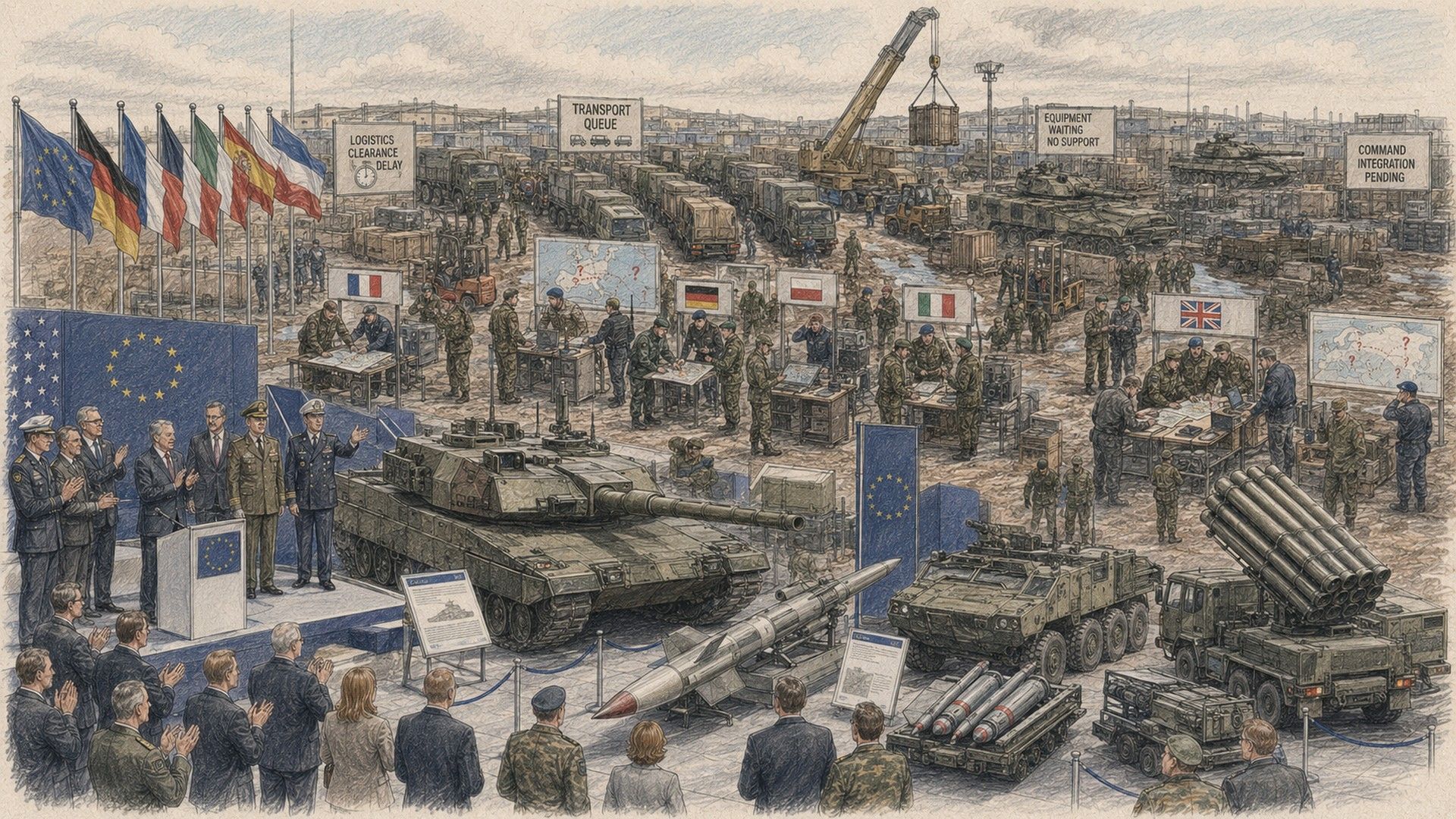
The Newsbrief points to the harder task: turning political promises into usable forces, stockpiles, mobility, command structures, air defence, long-range fires and industrial capacity. Europe cannot deter Russia with declarations and procurement plans stuck in national silos.
The question is no longer whether Europe spends more. It is whether Europe can build enough real military power before the next crisis exposes the gap.
Command must shift
A more European-led NATO means more than buying equipment.
Europe would need to take greater responsibility for planning, leadership and execution inside the alliance. That includes the ability to command large operations, move forces across the continent, sustain them under pressure and plug shortfalls if US assets are pulled elsewhere.
This is where the weakness bites. Europe has armies, but not always the backbone that makes them work together at speed.
The EU cannot hide behind NATO
The brief also points to a deeper institutional challenge.
The EU’s defence push, Readiness 2030 agenda, military mobility work and preparedness plans must connect with NATO’s operational needs. Brussels cannot build tools that look good on paper but fail to feed alliance defence plans.
NATO needs forces. The EU needs industrial and political muscle. If the two systems compete or duplicate, Europe wastes time it may not have.
The eastern flank cannot wait
For countries closest to Russia, this debate is not theoretical.
The Baltic states, Poland, Romania, Finland and others live with the immediate pressure of Russian military power, sabotage, cyber operations, drones and intimidation. They need credible reinforcement, air defence, logistics and pre-positioned stocks – not another round of abstract burden-sharing speeches.
If Europe wants to lead NATO, it has to prove it first where the risk is highest.
Europe must sell the sacrifice
RUSI’s wider warning is political as well as military.
European publics increasingly feel under threat, but that does not automatically translate into support for years of higher spending, tougher service models, industrial mobilisation and reduced dependence on US power.
Leaders must explain the bargain honestly. A safer Europe will cost money, attention and political courage. Pretending otherwise is how the continent got caught short.
The big warning: NATO cannot run on American habit forever.
The Newsbrief’s message is stark. Europe still needs the United States, especially for nuclear deterrence and high-end military support, but it can no longer build its defence strategy around automatic American leadership.
A European-led NATO will be difficult, expensive and politically messy. But the alternative is worse: an alliance where Europe waits for Washington while Russia tests the seams.
The comfort era is ending. Europe must learn to lead.