World Center for Strategic Studies
From closed analysis to public debate
- MONTH
- YEAR

NATO–EU Failure: Europe’s Security Machines Still Do Not Line Up
Europe has two giant institutions meant to protect it – NATO and the EU – yet the CEPA analysis argues that they still fail to work together with the urgency the threat demands. The problem is not a lack of summits, statements or polite language. It is the absence of hard alignment where it matters most.
Russia’s war, hybrid attacks, cyber threats, emerging technologies, climate security, military mobility and strategic competition all sit in the overlap between the two organisations. NATO has the defence backbone. The EU has money, regulation, industry and internal-security tools. Together, they should be a force multiplier.
Instead, the partnership too often looks like a missed opportunity dressed up as co-operation.
Two institutions, one threat picture
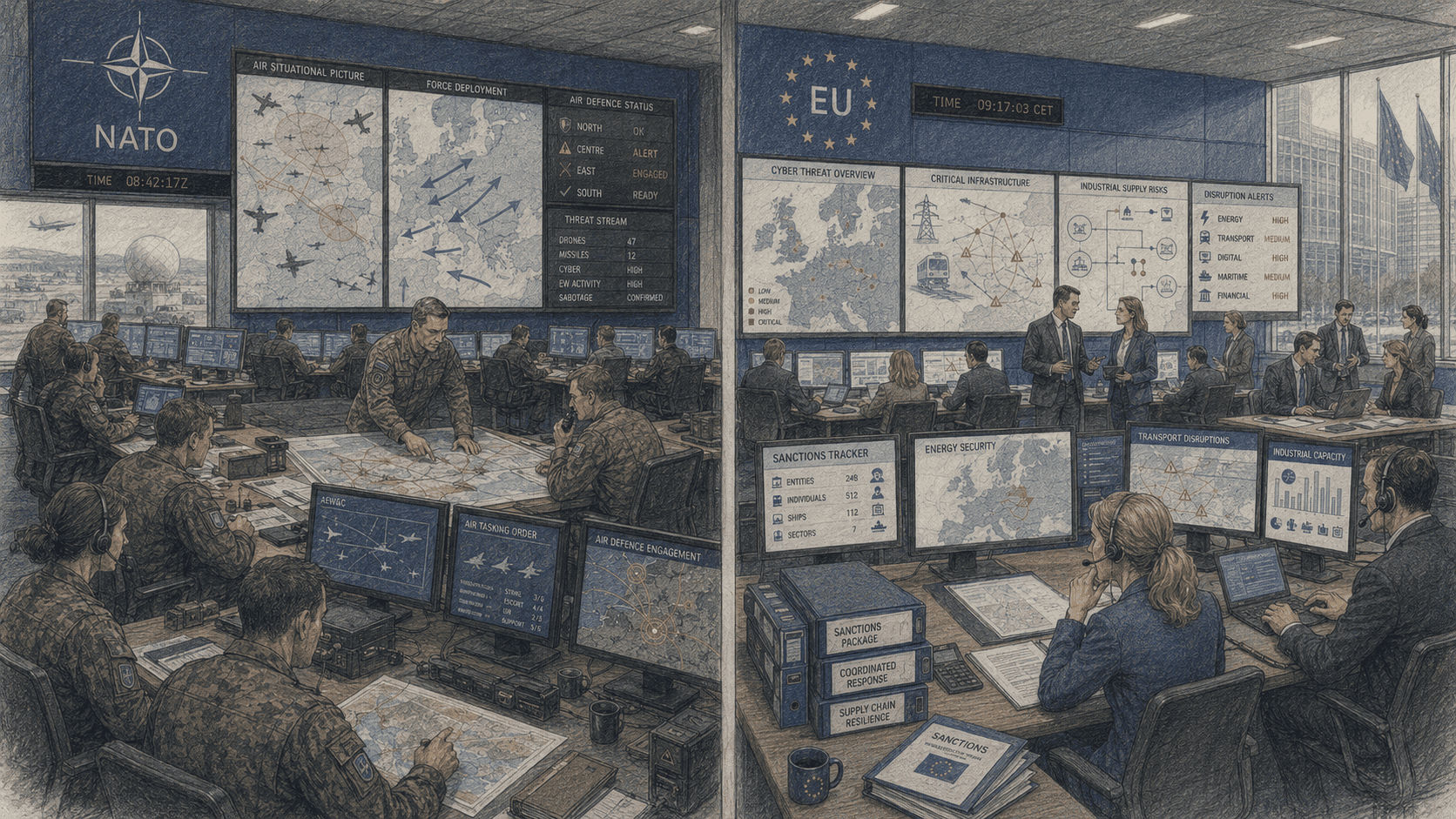
The analysis points to a simple fact: NATO and the EU are now dealing with many of the same strategic problems.
Resilience, technology, infrastructure protection, military mobility, cyber defence, China, Russia and instability on Europe’s periphery no longer fit neatly into separate institutional boxes. The old division of labour – NATO does hard security, the EU does economics and regulation – looks increasingly outdated.
Modern threats do not respect bureaucratic boundaries.
That is exactly why weak NATO–EU alignment is becoming so costly.
The communiqués are not enough
CEPA’s frustration is aimed at the gap between rhetoric and delivery. NATO and EU leaders keep reaffirming partnership, citing progress and promising deeper co-operation.
But the language remains too vague.
The NATO summit text referred to the EU partnership and listed areas of shared work, but offered little real detail on how the relationship should evolve. The EU–US statement covered many of the same challenges, yet did not put NATO at the centre of the discussion.
That is the problem. Everyone sees the overlap. Nobody is turning it into a serious joint operating model.
Europe keeps wasting momentum
The article argues that recent transatlantic summits should have produced a bigger step forward. After years of tension under Trump, there was a chance to rebuild US–European trust and finally push NATO–EU relations into a more ambitious phase.
Instead, the moment was mostly spent repairing damage rather than redesigning the system.
That may have been understandable. It was not enough.
At a time when adversaries are moving fast, Europe and North America cannot afford institutional comfort theatre.
Overlap is turning into weakness
The danger is not only duplication. It is that NATO and the EU may pursue parallel strategies that fail to reinforce one another.
If NATO develops defence plans while the EU designs industrial, technological and regulatory tools separately, the result is slower execution and weaker deterrence. If emerging technologies, resilience and infrastructure protection are handled through disconnected channels, rivals gain time and space.
The West does not need more policy silos. It needs aligned power.
Russia will not wait for process
The security environment has become more unforgiving since the relationship first began to improve.
Russia’s aggression has shown that military power, energy leverage, cyber operations, disinformation and infrastructure pressure can be used together. Hybrid conflict sits exactly in the space between NATO’s military role and the EU’s civilian, economic and regulatory strengths.
That should make co-operation unavoidable.
But if the two organisations continue to move cautiously, the West will remain slower than the threats it faces.
Strategic autonomy needs NATO reality
The EU’s security ambitions also create a delicate problem. Brussels wants a stronger role in defence, industry and geopolitical action. But Europe’s security still depends heavily on NATO, and NATO still depends heavily on the United States.
That makes alignment essential.
European defence initiatives that do not connect properly with NATO risk becoming politically attractive but strategically thin. NATO planning that ignores EU tools risks missing the economic and industrial base needed for long-term resilience.
Neither institution can do the full job alone.
The weakness rivals will exploit
CEPA’s broader warning is that poor NATO–EU alignment hands an advantage to adversaries.
Russia, China and other rivals benefit when Western institutions move slowly, protect turf or fail to combine military, economic and technological power. Fragmentation is not a technical inconvenience. It is a strategic vulnerability.
The West has the institutions. It has the resources. It has the threat picture.
What it still lacks is the discipline to connect them properly.
The last word: Partnership talk is not power
The CEPA analysis is a sharp reminder that NATO–EU co-operation cannot remain a diplomatic ritual. The threats facing Europe are too fast, too broad and too connected for polite institutional choreography.
NATO and the EU should be the twin engines of Euro-Atlantic security. Too often, they still look like parallel machines running at different speeds.
Europe does not need another statement praising co-operation.
It needs the two systems to align before the next crisis exposes the gap.