
World Center for Strategic Studies
From closed analysis to public debate

- MONTH
- YEAR

France’s Jobs Warning: Full Employment Promise Hits The Wall
France’s unemployment problem is creeping back – and the Institut Montaigne interview makes clear why politicians should stop pretending this is just a statistical blip. For the first time since 2021, unemployment has moved above 8 percent, with 2.6 million people affected.
Yet the public reaction is strangely muted. In 2015, unemployment was one of France’s top national obsessions. Today it sits far lower in voters’ priorities, even as the labour market quietly weakens.
That is the danger. France is not facing a sudden jobs crash. It is facing something more politically slippery: a slow return of unemployment while leaders still talk about full employment.
The rise is real
The increase is not just an accounting trick caused by RSA benefit recipients being automatically registered with France Travail.
Institut Montaigne’s Bertrand Martinot says the trend began around late 2022 or early 2023, after the end of emergency Covid-era support and amid weak productivity growth. French firms are now trying to rebuild productivity in a low-growth economy.
That means fewer net job creations – and therefore rising unemployment.
The economy is too weak to absorb the pressure
Trade wars, geopolitical shocks and higher hydrocarbon prices are making the situation worse. But the deeper problem is domestic and older: France’s economy is simply not growing strongly enough to keep creating jobs at the pace required.
This is the slow-burn version of labour-market trouble. Not mass layoffs. Not a spectacular recession. Just sluggish growth, weak hiring and a jobless rate that edges upwards quarter after quarter.
For a government that promised full employment, that is a nasty political trap.
Young people are still first in line for pain
The youth figure is the most alarming. Unemployment among 15–24-year-olds is around 20 percent.
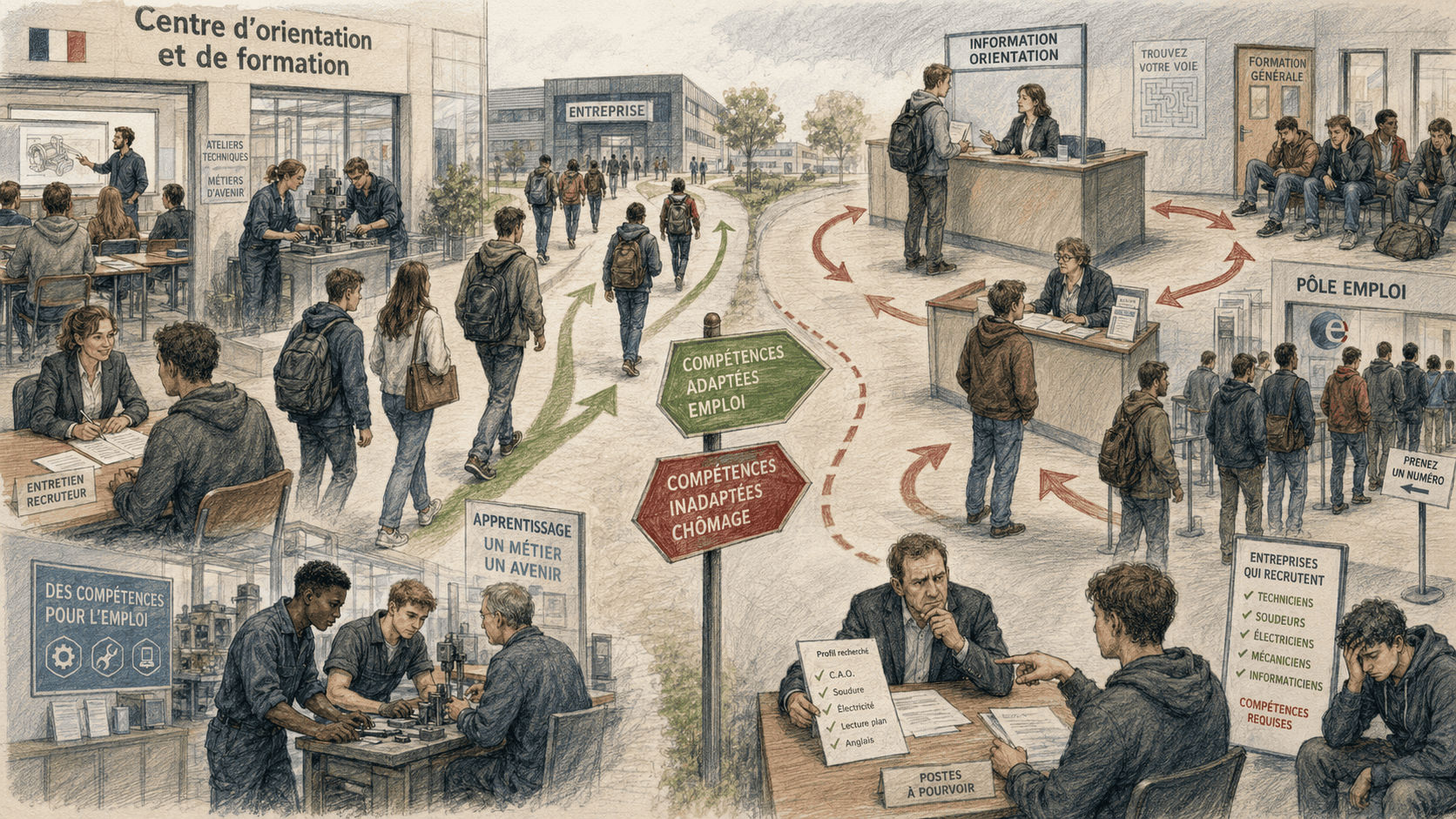
Martinot argues this is partly because firms adjust to a weaker economy mainly by reducing hiring, and young people are the first to suffer. The more worrying point is that France’s weakest-qualified young people remain trapped by poor initial training and failure-based career guidance.
For graduates, youth unemployment has fallen sharply. For low-skilled young people, the picture is much uglier.
That is not just a labour-market problem. It is an education failure showing up in jobless statistics.
France has more workers – but more unemployed too
One of the paradoxes is that France’s employment rate has reached 69.5 percent, its highest level since INSEE records began in 1975.
That sounds like good news. But it does not cancel the unemployment rise because the active population is also increasing. More seniors are staying in work because of pension reforms, while apprenticeship has moved hundreds of thousands of young people into employee status.
France has more people working. It also has more people looking for work.
That is why the headline numbers can look better while the pressure still rises.
The 5 percent promise is fantasy
Emmanuel Macron’s pledge to bring unemployment down to 5 percent now looks out of reach.
Martinot says reaching that level by 2027 would require roughly 900,000 net jobs in less than a year. That is plainly unrealistic in the current economic climate.
There is also a sharper point: if many neighbouring countries can think of frictional unemployment as 3 to 3.5 percent, it is unclear why France should treat 5 percent as the grand prize.
France has lowered its ambitions and still risks missing them.
Reforms helped – but did not fix it
The interview does not dismiss the labour-market reforms of recent years. Changes to unemployment insurance and employment rules may have reduced time spent out of work and made the labour market more resilient.
But that is not the same as victory.
The Banque de France has suggested structural reforms may have cut structural unemployment by around 1.3 points over ten years, though the estimate is fragile. Helpful, yes. Transformational, no.
Reform may be slowing the damage. It is not stopping the rise.
AI panic is too simple
The article also pushes back against the daily panic that artificial intelligence will wipe out work overnight.
Martinot argues that catastrophic predictions about technology destroying jobs have repeatedly failed. So far, AI appears to have created more jobs than it has destroyed, productivity gains remain weak, and major general-purpose technologies often take decades to reshape work properly.
But there is one real warning: white-collar and professional jobs may be more exposed this time than in previous technological shifts.
The issue is not whether AI kills work. It is whether France trains, regulates and adapts fast enough to turn disruption into productivity rather than unemployment.
The stark truth: France is drifting away from full employment
Institut Montaigne’s message is not panic. It is worse than panic: it is calm evidence that France’s jobs recovery is losing force.
Unemployment is rising, growth is flat, young low-skilled workers remain exposed, and the 5 percent target has slipped into political fiction.
France does not need another campaign slogan about full employment.
It needs an economy strong enough to hire – and a training system that stops feeding young people into failure.