World Center for Strategic Studies
From closed analysis to public debate
- MONTH
- YEAR

Europe’s Energy Panic Returns: The Options Are Running Out
Europe is once again facing an energy shock driven by events beyond its borders. As war in the Middle East pushes up oil and gas prices, governments are scrambling to protect households and industry from another surge in costs. But the CER assessment highlights an uncomfortable reality: Europe’s room for manoeuvre is far smaller than it was during previous crises.
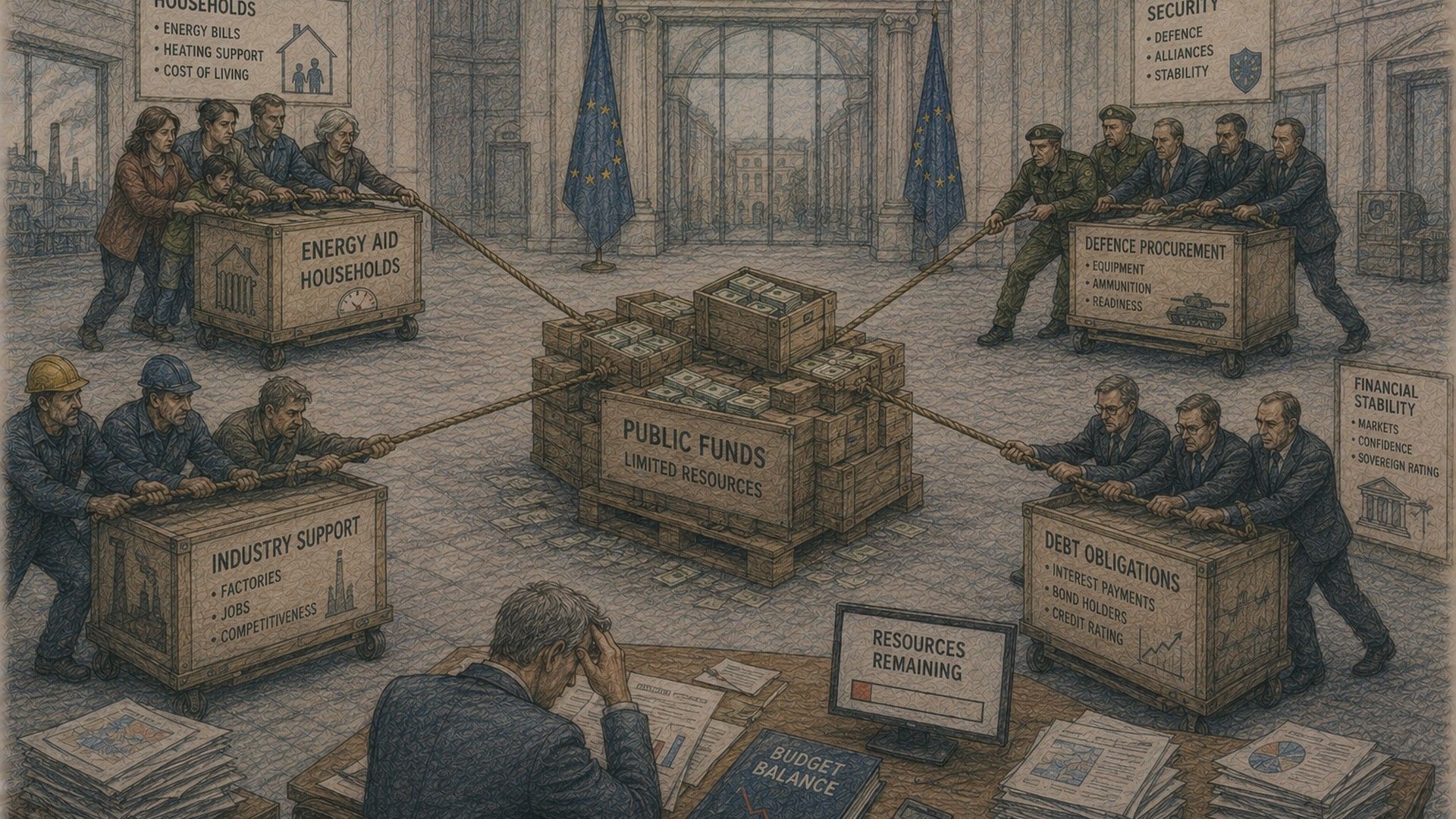
Public finances have weakened, debt levels have risen and governments are already stretched by defence spending, industrial subsidies and sluggish economic growth. The tools used during the 2022 energy crisis remain available, but many are now more expensive, politically harder to deploy and less effective than before.
The question is no longer whether Europe can cushion the blow. It is how much pain it can realistically afford to absorb.
The emergency toolbox is shrinking
During the last major energy crisis, European governments spent hundreds of billions supporting consumers and businesses through subsidies, tax cuts and price controls.
This time, the financial situation is far less comfortable. The CER analysis notes that public debt increased significantly after both the pandemic and the 2022 energy shock, while higher interest rates mean governments must devote more money to servicing debt.
That makes large-scale intervention harder to sustain. Every euro spent on energy relief competes with spending on defence, healthcare, pensions and industrial policy.
The era of unlimited emergency support is over.
Europe is paying for old dependencies
The latest crisis is exposing a problem that Europe still has not fully solved. Despite major investments in renewables and efforts to diversify suppliers, the continent remains highly exposed to disruptions in global fossil fuel markets.
The EU may have reduced its dependence on Russian energy, but it remains vulnerable to instability in the Gulf and disruptions affecting global oil and LNG flows. As energy prices rise, Europe again finds itself reacting to geopolitical events rather than controlling them.
The source of the shock has changed. The vulnerability has not.
National responses are pulling apart
One of the biggest dangers identified across the debate is fragmentation. Faced with rising prices, governments are increasingly reaching for national solutions rather than coordinated European ones.
Some countries are introducing tax cuts, others are subsidising consumers directly, while others focus on industrial support. The result is a patchwork of measures that risks distorting competition and weakening solidarity inside the single market.
When pressure rises, Europe often discovers how difficult collective action really is.
Brussels wants a long-term fix
The European Commission continues to argue that the only durable answer is faster electrification, greater deployment of renewable energy and reduced dependence on imported fossil fuels.
Officials increasingly frame the crisis as proof that energy security and decarbonisation are no longer separate objectives. Countries with stronger renewable generation, nuclear power and flexible electricity systems have generally been less exposed to recent price spikes.
The challenge is timing. Building resilience takes years. Energy shocks arrive in weeks.
Industry faces another squeeze
Europe's manufacturers may once again find themselves caught in the middle. Energy-intensive sectors that barely recovered from the last crisis now face renewed cost pressures.
Higher energy bills threaten competitiveness just as European companies are already struggling against lower-cost competitors in the United States and Asia. Governments want to protect industry, but fiscal constraints limit how much support they can provide.
The risk is not simply higher prices. It is another gradual loss of industrial capacity.
The weakness rivals exploit
Energy remains one of Europe's most persistent strategic vulnerabilities. External actors do not need to target Europe directly to inflict economic damage. Conflict in distant regions, shipping disruptions and commodity market volatility can all ripple through European economies with remarkable speed.
Every new crisis reinforces the same lesson: dependence creates leverage, and leverage creates vulnerability.
Europe has become more resilient since 2022, but not resilient enough.
The reality check: There is no painless solution
The CER assessment ultimately suggests that Europe faces a difficult balancing act rather than an easy fix. Governments can spend more, but budgets are strained. They can subsidise consumers, but the costs are enormous. They can accelerate the energy transition, but that takes time.
The continent is better prepared than it was four years ago. Yet it is still vulnerable to shocks it cannot prevent and struggles to coordinate responses when pressure rises.
Europe escaped the last energy crisis battered but intact.
The uncomfortable lesson is that the next one has already arrived.