World Center for Strategic Studies
From closed analysis to public debate
- MONTH
- YEAR

Mario Draghi Calls Europe to Action Again
On 4 February 2026, an article by Frederick Kempe, President and CEO of the Atlantic Council, was published on the Council’s website.
The publication analyzes a speech delivered by Mario Draghi, former president of the European Central Bank and ex prime minister of Italy, at the Leuven Catholic University, Belgium, on 2 February. In that speech, Draghi reiterated his suggestion that the EU should be reformed along the lines of ‘pragmatic federalism’. But this time it was sounded in the context of the United States’ economic and political pressure on the EU countries.
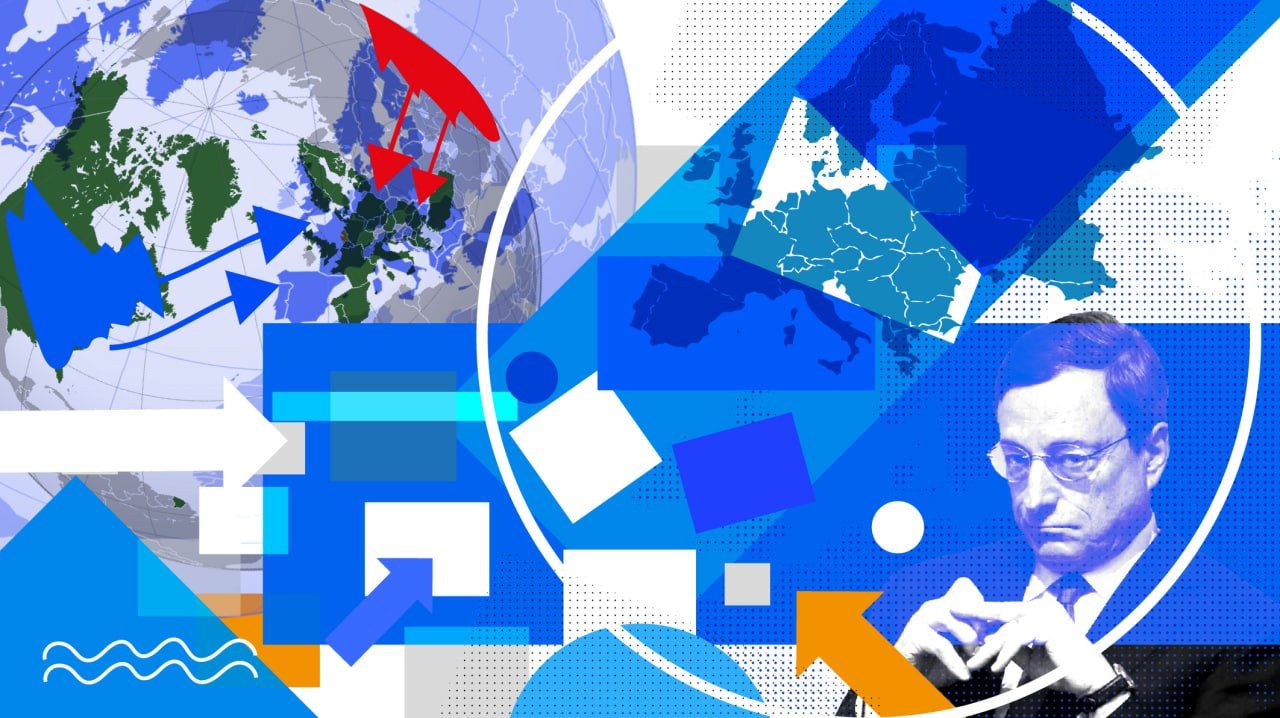
Mario Draghi calls for federalization of Europe not as a political or philosophical preference but as an urgent necessity caused by the actions of two great powers, China and the USA.
According to Draghi, the EU should move from a confederation to a European Federation. He terms it ‘pragmatic federalism’, with States joining forces in the fields of energy, technology, foreign policy, and defense. The author points out that in the areas where Europe is united (economy and monetary policy), it holds a strong position globally and is respected as a power.
The order that was established by the USA after the Cold war and has provided protection to Europe is breaking down. Russia is threatening European security. China is undermining the European manufacturing industries. The USA has turned more pragmatic.
Draghi’s speech continues a special address made by Canadian Prime Minister at the 2026 World Economic Forum in Davos, where Carney called on ‘middle powers’ to act together and oppose the ‘rupture’ in the world order.
Mario Draghi is building on his authority as the ‘savior of the euro’ during the Eurozone debt crisis of the early 2010s. Now he states that Europe lacks an institutional structure to counter the geopolitical and geo-economic challenges emanating from the United States and China.
The author recalls that the mission of the Atlantic Council he heads is to create a common global future together with its partners and allies. Although now the US leadership is accompanied by a more rigorous cost-benefit analysis, that is not to diminish America’s significance for Europe. Managing the global order entails not only costs to the United States but also common benefits.
Draghi joins in a growing chorus of European intellectuals who do not make their future a hostage of nostalgia for the times where the USA catered to Europe’s security and enabled it to develop as an economic union, despite its political fragmentation.
The author believes that Mr. Draghi’s speech will not be as historically significant as his call to save the Eurozone was in 2012. To justify it, Kempe deliberately downplays the significance of Draghi’s words by mentioning that he spoke at the Leuven Catholic University on the occasion of the honorable doctorate granted to him. To sum up his article, Kempe cites a quotation from the speech: ‘We are all in the position of vulnerability, whether we see it yet or not.’